SEO & Content Marketing
SEO for Electrical Contractors 2025
Are you an electrician or electrical contractor struggling to get found online? In today’s digital world, word of mouth isn’t enough. Whether you’re wiring new homes or servicing commercial buildings, your next customers are searching online—and if your business isn’t showing up, you’re losing leads. That’s where SEO for electricals comes in.
In this ultimate guide to electrical SEO, you’ll learn exactly how to get your website ranking higher on Google, drive more traffic, and convert visitors into paying customers. From smart keyword targeting and local SEO strategies to optimizing your website and tracking results, we’ll walk you through everything you need to build a powerful digital presence.
And if you’d rather skip the learning curve, we also offer web design, and SEO and digital marketing for home services tailored specifically for trades like yours. But first—let’s break down the strategies you can start using today to spark real growth.
Understanding SEO for Electrical Professionals
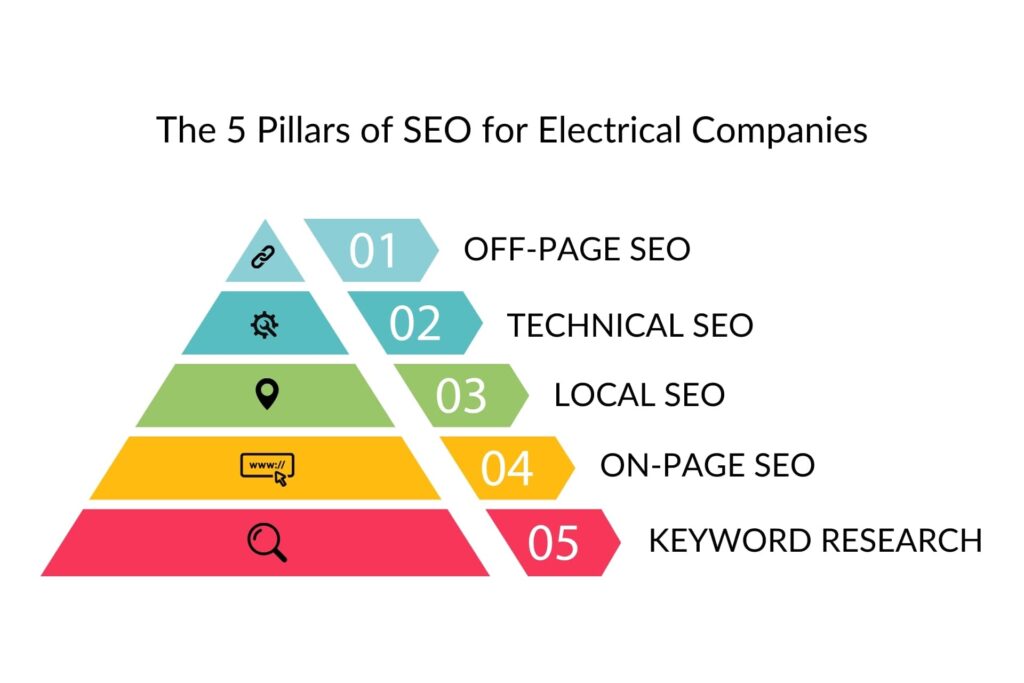
Before we dive into tactics, let’s break down the basics of electrical SEO—what it is, why it matters, and how it can help your business grow.
What is Electrical SEO?
Electrical SEO refers to the process of optimizing your website and online presence so that your electrical business appears at the top of search engine results when people search for services you offer—like “emergency electrician near me” or “electrical panel upgrade.”
It’s all about making sure Google (and your future customers) see your business as the most relevant, trustworthy option. SEO includes everything from the keywords on your website to your site’s speed, mobile-friendliness, reviews, and even the quality of links pointing to your site.
Why is SEO Important for Electrical Businesses?
Think about how people find electricians today. They don’t flip through the Yellow Pages—they open Google. If your business isn’t on that first page, most people will never find you.
Investing in SEO means:
- More website traffic from people actively searching for your services
- Higher-quality leads who are ready to book
- Increased brand visibility and authority in your local market
- Long-term marketing ROI without constantly paying for ads
Whether you’re a solo electrician or running a multi-crew operation, SEO can consistently drive leads and bookings—especially when paired with a well-designed website and CRM to manage those leads effectively.
Keyword Research for Electrical Contractors
To get found online, you need to speak the same language your customers are using in search engines. That’s where keyword research comes in. It’s the foundation of every successful electrical SEO strategy.
Identifying Primary and Secondary Keywords
Start by identifying the core services you offer and pairing them with the locations you serve. For example:
- Primary keywords: “residential electrician,” “emergency electrical services,” “electrical contractor [your city]”
- Secondary keywords: “electrical panel replacement,” “EV charger installation,” “licensed electrician nearby”
These keywords should reflect what people are actually typing into Google when they need your help. Use tools like Google Keyword Planner, Ubersuggest, or Ahrefs to validate search volume and competition.
Pro tip: Your homepage should target a broad keyword like “electrician in [city],” while specific service pages should target more niche phrases.
Using Long-Tail Keywords
While broad keywords bring traffic, long-tail keywords bring buyers. These are more specific, lower-competition phrases that usually indicate higher intent. Think:
- “licensed electrician for home renovation”
- “install GFCI outlet in kitchen”
- “24/7 emergency electrician in [city]”
These phrases may have lower search volume, but they convert better—because the person searching often knows exactly what they need. Including long-tail keywords in your service pages, blog posts, and FAQs can significantly boost your visibility and conversion rate.
Done right, keyword research not only helps you rank—it ensures the right people are landing on your site, ready to take action.
On-Page SEO Strategies for Electrical Websites
Once you’ve nailed down your keywords, it’s time to make sure your website is built to rank. On-page SEO is about optimizing the content and structure of your site so search engines understand exactly what you offer—and so visitors stick around once they land there.
Optimizing Title Tags and Meta Descriptions
Your title tag is the clickable headline that shows up in search results. It should include your main keyword and clearly reflect what the page is about. For example:
- Title: Emergency Electrician in Dallas – 24/7 Electrical Services
Your meta description doesn’t affect rankings directly, but it can make or break whether someone clicks. Use it to highlight your value and encourage action:
- Meta Description: Need an emergency electrician in Dallas? Fast, reliable, and available 24/7. Call now for immediate service.
Every page should have a unique title and meta description. Don’t reuse them across your site.
Utilizing Header Tags Effectively
Header tags (H1, H2, H3, etc.) help structure your content and make it easier for both readers and search engines to navigate. Your H1 should only appear once per page and include your primary keyword. Use H2s and H3s to break down content logically and include supporting keywords where relevant.
Think of headers like a table of contents—clear, organized, and helpful.
Creating High-Quality, Relevant Content
Your content needs to do more than mention keywords—it should answer questions, solve problems, and build trust. Here’s what works well on electrical websites:
- Service pages with clear descriptions of what’s included
- Helpful blog posts (e.g., “How to Tell If Your Home Needs a Rewire”)
- Location-specific content for areas you serve
- FAQs that target common client concerns
Keep it readable, informative, and client-focused. You’re writing for real people, not just Google.
Image Optimization Techniques
Images make your site visually appealing, but they also need to be optimized. Here’s how:
- Use descriptive file names (e.g., breaker-panel-installation.jpg)
- Add alt text that describes the image and includes relevant keywords
- Compress image sizes to improve load speed
- Use modern formats like WebP when possible
Optimized images support accessibility, improve page speed, and give search engines more context about your content—all of which help with SEO.
Off-Page SEO for Electrical Businesses
While on-page SEO optimizes your website itself, off-page SEO focuses on what happens outside your site that still impacts your rankings—especially trust, authority, and visibility. For electrical businesses, this is your chance to build a strong reputation across the web and get in front of more local customers.
Building Quality Backlinks
Backlinks—links from other websites to yours—act as votes of confidence in the eyes of search engines. But not all links are created equal.
Aim for backlinks from:
- Local directories (like Yelp, Angi, and Houzz)
- Industry-specific sites (e.g., electrician associations or contractor networks)
- Relevant blogs or news outlets (especially if you’ve done noteworthy work or community projects)
You can also earn backlinks by contributing expert quotes, writing guest articles, or publishing helpful guides that others want to reference.
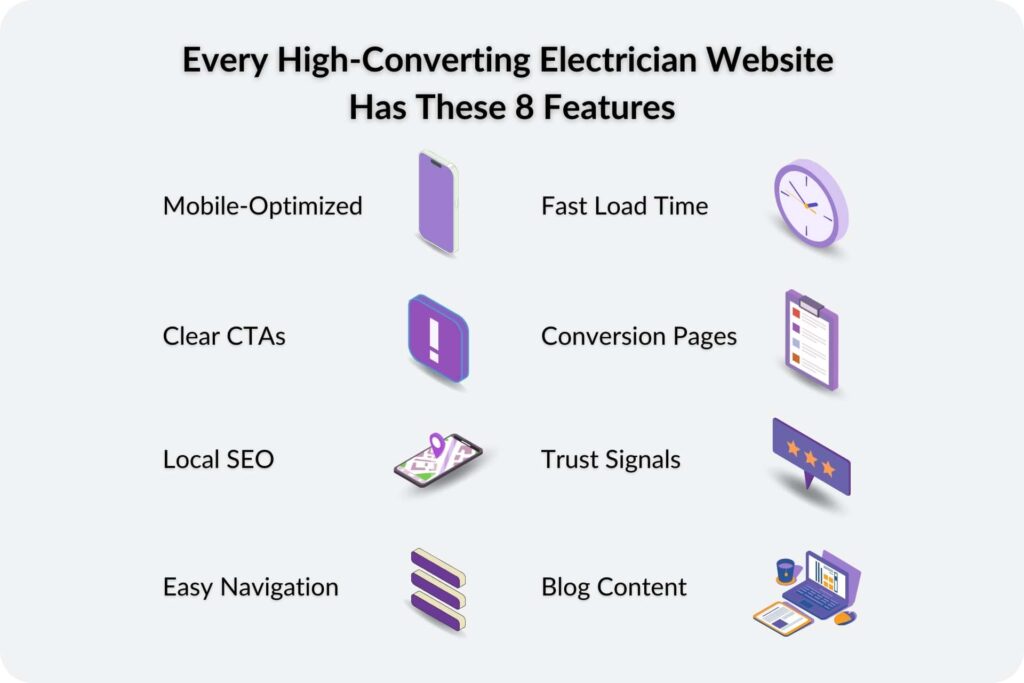
Leveraging Local SEO
Local SEO is especially critical for electricians since most customers are looking for nearby services. To dominate your local area:
- Claim and optimize your Google Business Profile with up-to-date info, photos, service areas, and hours
- Add your business to local directories and mapping services
- Ensure your NAP (Name, Address, Phone number) is consistent across the internet
- Use location-based landing pages if you serve multiple towns or cities
Local SEO can help your business show up in Google’s “map pack,” which is often the first thing people see when searching for services in their area.
Managing Online Reviews and Ratings
Reviews are more than social proof—they directly influence your local search rankings. Encourage happy customers to leave reviews on Google, Facebook, and industry platforms. Respond professionally to all reviews, even the negative ones, to show you value customer feedback.
To streamline this, consider automating review requests after each job. A steady flow of genuine, positive reviews can set you apart from competitors and improve your visibility at the same time.
Technical SEO for Electrical Websites
Even the best content won’t perform if your site has technical issues. Technical SEO ensures that search engines can crawl, index, and understand your site properly—while also making the user experience fast, smooth, and secure.
Ensuring Mobile-Friendliness
Most people searching for electrical services are doing it from their phones. If your site doesn’t load properly on mobile, you’re losing leads. A mobile-friendly website should:
- Display clearly on all screen sizes
- Have clickable buttons and readable text
- Load quickly on mobile connections
You can use tools like SE Ranking’s Mobile-Friendly Test to check your site and address any issues.
Improving Site Speed
Site speed affects both rankings and bounce rates. A slow-loading website creates friction, especially for users who need urgent help—like in the case of power outages or electrical emergencies.
Speed up your site by:
- Compressing images
- Minimizing the use of bulky scripts
- Using fast, reliable hosting
- Leveraging browser caching and lazy loading
Even small improvements can make a big difference in how search engines (and users) respond to your site.
Securing Your Website with HTTPS
Security is a ranking factor—and a trust factor. If your site still shows “Not Secure” in the browser bar, it’s time to upgrade. Installing an SSL certificate ensures your site loads via HTTPS, encrypting data and signaling to visitors that your business is legitimate and trustworthy.
Most hosting providers offer free SSL certificates, and setting one up is typically straightforward.
Want help with you SEO and digital marketing? Negosense is a digital marketing agency for home service contractors.
Content Marketing for Electrical Services
If SEO brings people to your site, content marketing keeps them there—and turns visitors into customers. For electricians, great content builds trust, answers common questions, and positions you as the go-to expert in your area.
Creating Informative Blog Posts

Blog posts aren’t just filler—they’re powerful tools for driving targeted traffic. Focus on topics your potential clients are already searching for, such as:
- “How to reset a tripped circuit breaker”
- “Signs your home needs a wiring upgrade”
- “What to expect during a panel replacement”
The goal is to educate without overwhelming. Use clear language, break down technical topics, and always link back to your services when relevant.
Using Videos and Infographics
Not everyone wants to read long blocks of text. Short videos and visual guides are a great way to simplify complex concepts and showcase your expertise. Try:
- Quick videos explaining common electrical issues
- “Before and after” project spotlights
- Infographics showing the cost savings of energy-efficient upgrades
These formats are highly shareable, boost engagement, and can improve time spent on your site—a positive signal to search engines.
Engaging with Social Media
Social media might not drive leads directly, but it builds visibility and reinforces your brand. Share useful tips, behind-the-scenes looks at projects, and customer success stories. Platforms like Facebook, Instagram, and even LinkedIn are perfect for:
- Sharing your latest blog post or video
- Highlighting glowing reviews
- Posting limited-time service offers
Consistency is key—post regularly and respond to comments to stay top-of-mind with your audience.
Interested in learning more? Check out the Ultimate Guide to Digital Marketing for Home Services, or our article with 24 Electrical Advertising Ideas.
Tracking and Measuring SEO Success
Doing SEO without tracking results is like fixing a panel without testing the current—you’re guessing. To know whether your efforts are paying off, you need to monitor key metrics and make data-driven decisions.
Key Metrics to Monitor
Focus on metrics that tie directly to your business goals, not just vanity numbers. Some of the most useful include:
- Organic traffic – How many people are finding you through search engines
- Keyword rankings – Where your site ranks for target search terms
- Click-through rate (CTR) – How often people click your listing in search results
- Bounce rate – Whether visitors stay and engage or leave quickly
- Conversions – How many visitors are filling out forms, calling, or booking services
Tracking these over time shows you what’s improving and where you might be losing potential leads.
Tools for Tracking SEO Performance
Several tools can make tracking easy, even if you’re not a marketing pro:
- Google Analytics – Understand how visitors interact with your site
- Google Search Console – See what keywords you’re ranking for and fix indexing issues
- Rank tracking tools (like Ubersuggest, Ahrefs, or SEMrush) – Monitor keyword positions
- Call tracking or form tracking – Attribute leads to specific pages or campaigns
If you’re working with an SEO provider (or considering it), make sure they provide regular reports and explain what the numbers actually mean for your business.
Common SEO Mistakes to Avoid
Even with the best intentions, small missteps can prevent your site from ranking—and worse, cost you leads. Here are some of the most common SEO pitfalls electrical businesses should steer clear of.
Keyword Stuffing
Yes, keywords are important—but overusing them can hurt more than help. Repeating phrases like “licensed electrician” in every sentence not only looks unnatural to visitors, but also signals spammy behavior to search engines.
Instead, focus on writing naturally for your audience. Use keywords where they make sense, and let quality content do the heavy lifting.
Ignoring Local SEO
If your business serves a specific area, skipping local SEO is a missed opportunity. Failing to claim your Google Business Profile, using inconsistent contact info across the web, or not mentioning your service area on your site can tank your visibility in local searches.
Local SEO isn’t just an add-on—it’s a core part of showing up for high-intent customers nearby.
Neglecting Mobile Users
Even if your website looks great on a desktop, it might fall apart on a phone. If mobile visitors struggle to click buttons, read text, or load pages quickly, they’ll leave—and so will your rankings.
Mobile usability is now a top ranking factor. A responsive, easy-to-navigate mobile site is no longer optional.
Ready to Outrank Competitors and Power Up Your Growth?
If you’re serious about standing out online and winning more jobs, investing in SEO for electricals isn’t optional—it’s essential. A strong SEO strategy does more than boost your visibility; it positions your business as the trusted solution when customers need electrical work done right.
But let’s be real—running a business and mastering electrical SEO at the same time is a lot to juggle.
That’s where we come in.
Negosense is a full-service digital marketing agency for home service businesses and commercial contractors. We specialize in helping electrical professionals like you grow through conversion-focused web design, smart CRM integrations, and proven SEO and lead generation strategies. Whether you’re just getting started or looking to scale, we’ll help you build a system that brings in qualified leads month after month.
Book a free strategy call to see what’s holding your site back—and how we can fix it fast.
Let’s spark serious growth in your business. No fluff. Just results.