Paid Ads & Lead Generation
Run Profitable Cleaning Ads on Google & Facebook
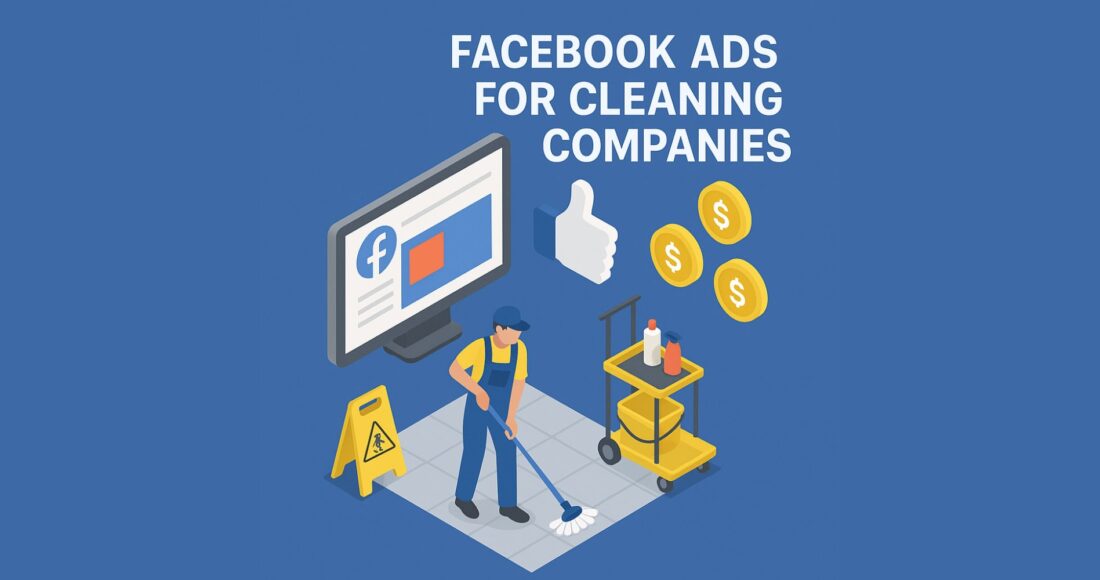
Looking for a faster way to get more cleaning clients? Tired of waiting for word of mouth or organic SEO to kick in? Ads might be your answer — if you run them the right way.
The truth is, most cleaning businesses waste money on ads that don’t convert. They throw up a generic post on Facebook or boost a low-quality image without strategy, targeting, or follow-up.
This guide walks you through exactly how to run paid ads that actually grow your cleaning business. Whether you’re a solo cleaner or managing a full team, we’ll break down:
- Which platforms work best (and when to use them)
- How to write ad copy that gets clicks and bookings
- Budget tips for getting results without overspending
- Real-world examples of how to split your ad budget for maximum ROI
If you’re wondering how ads fit into the bigger picture, check out our Ultimate Guide to Digital Marketing for Home Services.
Why Cleaning Business Ads Work (and Convert Faster Than SEO)
Paid ads give you something that most marketing channels can’t: instant visibility with people who are already looking for cleaning help.
Instead of waiting for your SEO to kick in or for your flyers to be noticed, Google Ads and Facebook Ads put you right in front of potential clients — exactly when they’re ready to buy.
Here’s why ads work especially well for cleaning businesses:
1. The Buying Intent is Already There
If someone searches for “move-out cleaning near me” or “weekly maid service,” they’re not just browsing. They’re looking for a solution right now. Running search ads lets you intercept them at that moment.
2. You Can Target Locally
Cleaning is a hyper-local business. Ads let you target people by zip code, city, or radius — which means you’re only paying to reach people who are actually in your service area.
3. You Control the Flow of Clients
Want to grow fast? Turn up your ads. Need to slow down and catch up on work? Pause or scale back. Paid ads give you control over how many leads come in — something referrals and SEO can’t do.
4. It’s Scalable with the Right Systems
The best part? When you combine ads with automation (like a CRM or follow-up system), you can scale without drowning in admin work. Leads come in. Your system follows up. You book more jobs without lifting a finger.
Need help managing your ads campaigns? Check out offerings on PPC for Home Services.
If you’re curios about SEO, check out our article about SEO for Home Services.
Best Advertising Platforms for Cleaning Businesses: Google, Facebook, LSAs
Not all ad platforms are created equal. The best one for your cleaning business depends on your goals, budget, and how soon you want results.
Let’s break down the three platforms that actually move the needle for cleaning businesses — and when to use each.
How to Use Google Ads for Your Cleaning Business
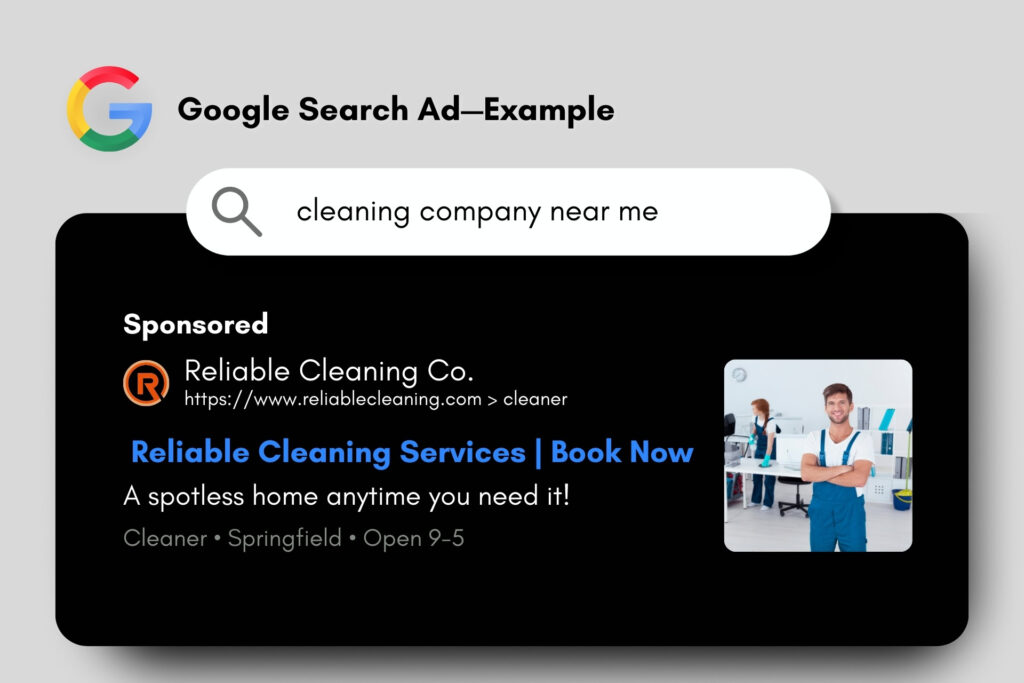
When someone types “deep cleaning service near me” into Google, they’re not looking for cleaning tips — they’re looking to hire right now. That’s why Google Ads are the highest-intent option you can run.
Best for:
- Quick lead generation
- Clients ready to book ASAP
- Targeting people actively searching for cleaners
How It Works:
You bid on keywords like “house cleaning service” or “move-out cleaning.” When someone searches, your ad appears at the top of the page. You pay only when someone clicks.
There are two main formats to consider:
- Search Ads: Traditional text ads that show up when someone searches.
- Local Services Ads (LSAs): These appear above regular search ads and show your star rating, service area, and phone number — perfect for local cleaners.
Pro Tip:
Send people to a dedicated landing page with a clear call to action (like “Get a Free Quote” or “Book Now”). Don’t just link to your homepage — it leaks conversions.
How to Run Facebook Ads for a Cleaning Business
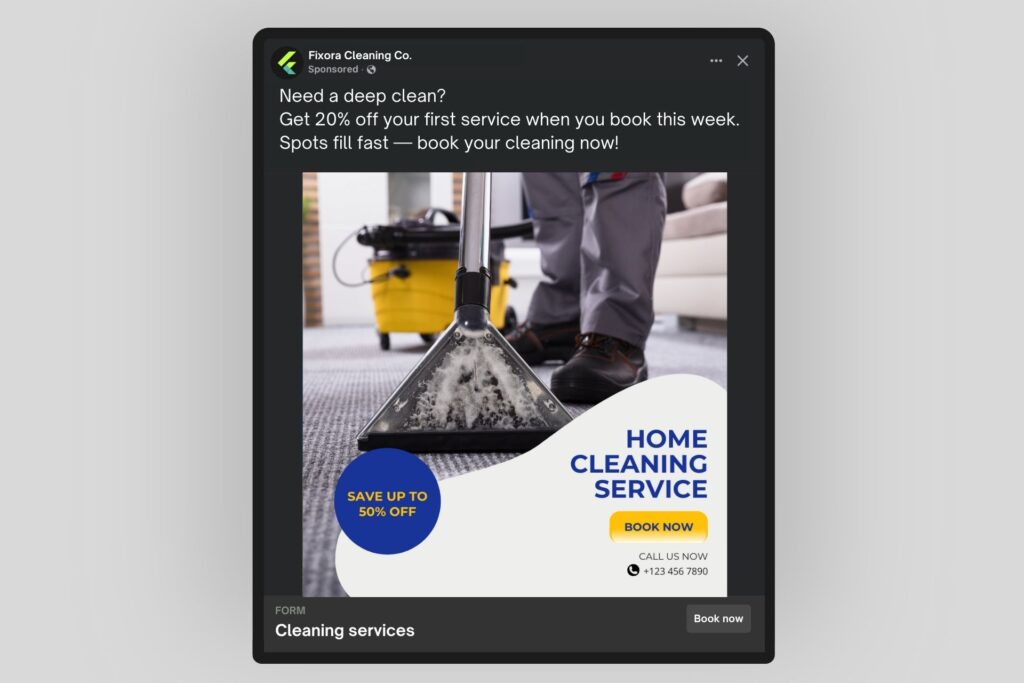
Facebook doesn’t have the same “ready to book” intent as Google — but it can be incredibly effective for building brand awareness and generating leads over time.
Best for:
- Getting in front of local homeowners
- Retargeting people who visited your site
- Promoting seasonal offers (spring cleaning, move-out specials)
How It Works:
You target people by location, age, interests, income, home ownership status, and more. You can run ads that drive traffic to your website, generate messages, or collect leads right inside Facebook.
Pro Tip:
Use before-and-after photos or short videos showing your team in action. Local customers love seeing real results from nearby businesses.
What About Instagram, YouTube, or TikTok?
These platforms can work — especially if you have visual content or want to build your brand long-term — but they’re secondary for most cleaning businesses.
If you’re just getting started, stick to Google and Facebook. They’ll bring you leads the fastest and give you a clear return on your ad spend.
Cleaning Ads Cost Breakdown: How Much to Budget for Google & Facebook
Let’s cut through the fluff: cleaning ads don’t have to break the bank — but you do need a smart budget and a clear strategy to avoid burning money.
What You Can Expect to Spend
Based on market data, here’s a rough breakdown of cost per click (CPC) for cleaning industry keywords:
| Platform | Average CPC | Notes |
| Google Search | $2 – $6 | Higher intent, faster bookings |
| Local Services Ads | Pay-per-lead | Typically $20–$40 per qualified lead |
| Facebook Ads | $0.50 – $2 | Great for retargeting or building awareness |
Note: These are average ranges. Your actual cost will depend on your location, competition, and how well your ads are set up.
What Actually Drives the Cost
Paid ads aren’t like a vending machine — it’s not just “put in $5, get back a lead.” Several factors influence how far your ad budget goes:
- Ad quality: Better ad copy and creative = lower costs per click
- Targeting: Narrow, well-defined audiences cost less than broad, messy ones
- Landing page experience: Google and Facebook reward you for sending people to a well-optimized page
- Offer clarity: A simple, specific offer like “$100 Off First Cleaning” tends to perform better than generic ads
Budgeting Smart — Even on a Small Scale
If you’re just starting out, don’t throw $1,000 at ads and hope for the best. Here’s a smarter way to test the waters:
- Start with $10–$20/day on Google Search or LSAs
- Use Facebook to retarget site visitors with $5–$10/day
- Monitor results daily for 2–3 weeks before scaling
Once you see leads coming in consistently, you can gradually increase your budget while keeping ROI high.
Google Ads Setup Guide for Cleaning Businesses (Step-by-Step)
Google Ads can be one of your most powerful lead generation tools — but only if it’s set up correctly. Most cleaning businesses either overspend or underperform because they rush the setup, skip keyword research, or send traffic to a generic homepage.
Here’s how to build a Google Ads campaign that actually gets results.
Step 1: Choose the Right Campaign Type
For most cleaning businesses, you’ll want to start with:
- Search Campaigns – These show your text ads when someone searches for cleaning-related keywords.
- Local Services Ads (LSAs) – These charge per lead, not per click, and only show to people in your service area. If available in your region, LSAs are a no-brainer.
Tip: Start with Search campaigns if LSAs aren’t available in your area. Once you’re approved for LSAs, they often outperform traditional ads.
Step 2: Nail Your Keyword Targeting
Don’t just guess. Focus on high-intent, location-based search terms like:
- “house cleaning service [your city]”
- “deep cleaning near me”
- “move out cleaning [zip code]”
Avoid broad terms like “cleaning” or “maid” without qualifiers — they’ll eat your budget fast without bringing in buyers.
Use match types strategically:
- Phrase Match (“house cleaning”) = Safer, more targeted
- Exact Match ([move out cleaning]) = Very specific
- Broad Match = Only use with caution + lots of negative keywords
Step 3: Write Ads That Speak Directly to Pain Points
Great Google Ads aren’t clever — they’re clear. Focus on what people need solved today. Your ad copy should answer this question:
“Why should I click you instead of the next guy?”
Structure to follow:
- Headline 1: “Trusted Cleaning in [City]” or “Fast Move-Out Cleaning”
- Headline 2: “Book in 60 Seconds” or “$50 Off This Week”
- Description: Highlight benefits (flexible scheduling, eco-friendly, 5-star reviews)
Use ad extensions to take up more space and drive clicks:
- Call extensions so people can call directly
- Location extensions for trust and visibility
- Site links to your services or booking page
Step 4: Send People to a Page Built to Convert
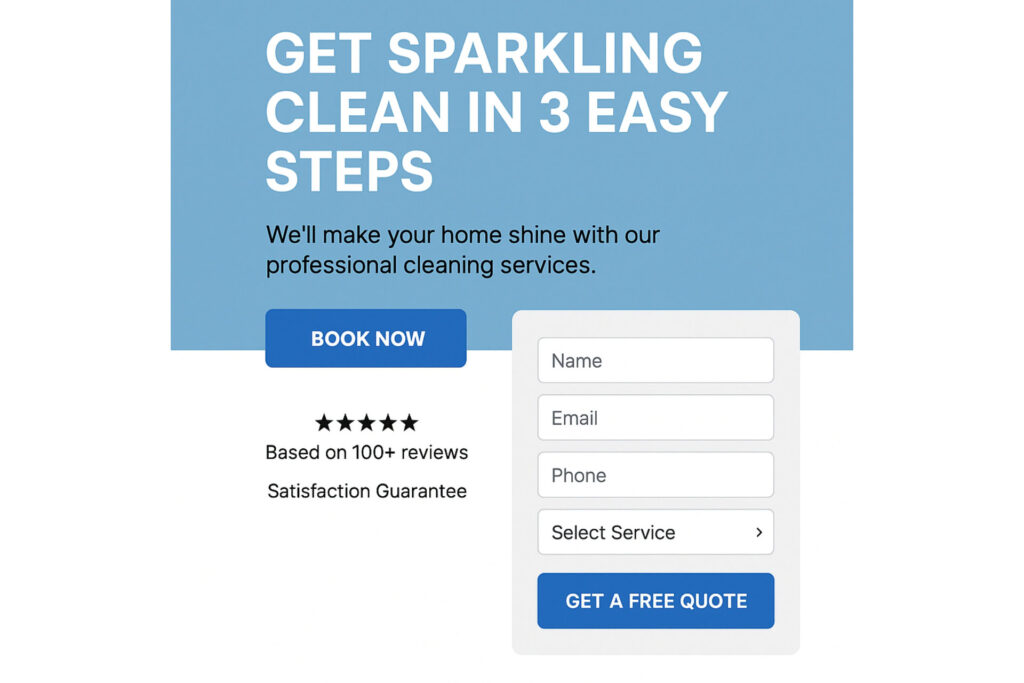
<<<<<<<
- A bold headline (“Get Sparkling Clean in 3 Easy Steps”)
- A short description of your service
- A clear call to action (“Book Now” or “Get a Free Quote”)
- Trust elements (reviews, badges, guarantees)
- A mobile-friendly form or booking widget above the fold
If you don’t have one, we set these up for cleaning businesses — optimized from day one. (More on that later.)
Facebook Ads for Cleaning Businesses: Setup & Strategy Guide
Unlike Google, Facebook isn’t about catching people who are actively searching — it’s about getting in front of the right people before they start looking, or reminding them you exist once they’ve visited your site.
Done right, it’s one of the most affordable ways to stay top of mind in your local market — and turn cold traffic into booked jobs.
Step 1: Choose the Right Campaign Goal
When creating your campaign, Facebook will ask what your objective is. For cleaning businesses, you’ll want to focus on one of these:
- Lead Generation – Collect names and phone numbers directly inside Facebook (great for simple promos).
- Messages – Start conversations through Messenger or WhatsApp.
- Traffic – Send visitors to your booking page or quote form.
- Conversions – Track bookings if your website has a thank-you page and a Facebook Pixel installed.
If you don’t have a Pixel set up yet, start with Lead Generation or Messages. They’re easier to track and still deliver quality leads.
Step 2: Target the Right People
One of Facebook’s biggest strengths is precise audience targeting. For local cleaning businesses, here’s how to dial it in:
- Location: Target by zip code, city, or a 10–15 mile radius around your service area.
- Demographics: Homeowners aged 30–60 often book the most cleanings.
- Interests: Try layering in filters like “recently moved,” “home improvement,” or “parents with young children.”
You don’t need to overcomplicate it. Start simple, test, and optimize based on what brings in real leads.
Step 3: Build Creative That Gets Clicks
People scroll fast — your ad needs to stop them in their tracks. That doesn’t mean flashy. It means relevant.
Here’s what works:
- Before-and-after photos of real cleanings
- Short videos showing your team in action
- A relatable caption that addresses a pain point:
“Too busy to clean before guests arrive? We’ve got your back.”
Include a special offer to increase urgency, like:
- “10% Off for First-Time Clients”
- “Spring Deep Clean Special – Limited Spots”
Pair that with a clear CTA like “Get Quote” or “Send Message.”
Step 4: Retarget Visitors Who Didn’t Book
If someone clicks your ad or visits your site but doesn’t convert, you can retarget them with a follow-up ad. These often get better results at a lower cost.
Examples:
- “Still thinking about getting help with cleaning? Let’s make it easy.”
- Show testimonials or reviews in your retargeting ad to build trust.
You’ll need the Facebook Pixel installed on your website to enable this — but it’s worth doing. Retargeting warms people up until they’re ready to book.
$500 Cleaning Ads Budget Plan: Google & Facebook Breakdown
You don’t need a massive budget to run profitable ads — but you do need to allocate it with intention. Whether you’re just getting started or testing new markets, $500 can go a long way if spent strategically.
Here’s a proven way to split that budget across platforms and objectives to get real results.
Suggested $500 Budget Split
| Channel | Purpose | Allocation |
| Google Search Ads | High-intent lead generation | $250 |
| Facebook Lead Ads | Local awareness + warm lead gen | $150 |
| Facebook Retargeting | Re-engage site visitors/clickers | $50 |
| Buffer for Testing | A/B creative or copy tests | $50 |
Google Ads: $250
Goal: Get bookings or quote requests from people actively searching for your services.
- Target 3–5 high-intent keywords related to your niche and location.
- Set a daily budget of ~$10.
- Focus on a single service (like move-out cleaning or recurring home cleanings) to stay relevant.
Expected Outcome:
You might pay $3–$5 per click. If your landing page is solid, you could see 10–15 leads with proper targeting and optimization.
Facebook Lead Ads: $150
Goal: Capture interest from homeowners who aren’t actively searching but are open to booking.
- Use a simple form that collects name, email, and phone.
- Pair it with a clean offer (e.g., “$50 Off First Cleaning”).
- Target a tight radius around your service area.
Expected Outcome:
Depending on your targeting and creative, you might pay $5–$10 per lead. You could walk away with 15–30 leads to follow up on.
Facebook Retargeting: $50
Goal: Convert visitors who clicked but didn’t book.
- Create a short, punchy ad with a testimonial or reminder:
“Still need help cleaning before the weekend? We’ve got you covered.” - Only show to people who’ve clicked your website or lead ad in the last 7 days.
Expected Outcome:
These ads often convert at a lower cost because the audience is already warmed up. Expect a handful of extra leads or messages here — and sometimes even direct bookings.
Test Budget: $50
Goal: Test two versions of your ad to see which performs better — this could be:
- A different image (team vs. sparkling kitchen)
- A stronger CTA (“Get a Free Quote” vs. “Book Now”)
- A different offer (discount vs. free add-on)
Why it matters:
Even small creative tweaks can cut your lead cost in half — this buffer lets you find out what actually works without risking your core budget.
Final Tip: Track Everything
Don’t run ads blind. Use:
- UTM parameters on landing pages to track Facebook traffic
- Conversion tracking in Google Ads
- A spreadsheet or CRM to monitor lead source and close rates
This lets you see which platform is generating real clients — and which needs a tweak. Want help setting up a lead generation engine that works around the clock? We provide lead generation for home services.
Advertising Mistakes Cleaning Businesses Should Avoid
Running ads isn’t just about spending money — it’s about spending it efficiently. Unfortunately, many cleaning businesses lose time and budget by making avoidable mistakes early on.
If you’ve ever felt like “ads just don’t work for me,” chances are you’ve hit one of these traps. Here’s how to steer clear of them.
Mistake #1: Sending Traffic to a Generic Homepage
Your homepage might look nice, but it’s probably not designed to convert ad clicks into paying customers. When people click on an ad, they expect one thing — a fast, frictionless way to get what was promised in the ad.
Fix:
Send people to a dedicated landing page with a clear offer, a prominent call-to-action, and zero distractions. Every extra menu item or vague headline increases the chance they’ll bounce.
Mistake #2: Using One Ad for Everyone
Blanket messaging like “We clean homes!” doesn’t move the needle. Why? Because not all cleaning needs are the same. Someone moving out wants different messaging than someone looking for weekly service.
Fix:
Create specific campaigns for specific services (e.g., post-renovation cleaning, deep cleans, move-in/move-out). Match your ad creative and copy to each pain point.
Mistake #3: Ignoring the Follow-Up
Getting a lead isn’t the same as closing a job. Many cleaning businesses let leads go cold because they don’t follow up quickly — or at all.
Fix:
Use automation. Even a simple CRM or follow-up tool can send a confirmation email, a text message, or a booking reminder. Leads should never sit unanswered.
Mistake #4: Giving Up Too Soon
Ad platforms often need 7–14 days to optimize performance. Many business owners panic after a few slow days and shut everything off — missing out on the upside once the algorithm has enough data to improve results.
Fix:
Commit to a minimum 2-week test with a set budget. Track clicks, leads, and conversion quality — then adjust. Don’t expect miracles on day one.
Mistake #5: No Tracking, No Clarity
If you’re not tracking which ads generate actual bookings, you’re flying blind. It’s easy to spend hundreds without realizing you’re getting leads from the wrong keywords or audiences.
Fix:
- Install the Facebook Pixel and Google conversion tracking
- Use UTM links to see which ad variations drive results
- Monitor cost per lead and cost per booking separately
These mistakes are common — but they’re also fixable. Clean up your strategy, and your ads will go from “just spending money” to predictably bringing in new business.
Running Cleaning Ads: DIY vs Hiring a Marketing Expert
It’s a question every cleaning business owner eventually faces:
Should I learn how to run ads myself — or pay someone to do it for me?
There’s no one-size-fits-all answer. It depends on your time, budget, and how quickly you want to scale.
Here’s a breakdown to help you make the right call.
When It Makes Sense to DIY
You might be better off managing ads yourself if:
- You’re just starting out and need to stay lean
- You enjoy learning marketing tools and testing ideas
- You have a few hours per week to watch performance, tweak creatives, and respond to leads
- You’re running basic campaigns with a small budget (under $500/month)
Upside: You stay in control, learn valuable skills, and save money.
Downside: There’s a learning curve, and you’ll likely burn some budget on trial and error before things work smoothly.
Tip: If you go this route, start with one platform (Google or Facebook), keep campaigns simple, and use templates to build high-converting landing pages.
When It’s Time to Bring in a Pro
Hiring a marketing expert or agency is a smart move when:
- You’re spending $1,000+/month and want to maximize every dollar
- You want to scale quickly without spending weeks learning ad platforms
- You’ve tried running ads before and got inconsistent or disappointing results
- You’d rather focus on running the business, not running the ads
A good partner doesn’t just run ads — they help you:
- Identify your most profitable services and offers
- Write ad copy that converts clicks into bookings
- Track results and continually optimize for ROI
- Set up systems that automatically follow up with leads
It’s not about outsourcing tasks — it’s about buying back your time and getting results faster.
What to Watch Out For
If you do hire help, don’t just choose the cheapest option. Look for someone who:
- Specializes in local service businesses (or better yet, cleaning companies)
- Understands both ads and conversion strategy — not just one or the other
- Offers clear reporting and doesn’t hide behind jargon
- Can align their strategy with your growth goals — not just impressions and clicks
Whether you do it yourself or hire someone, remember this:
Ads are just a tool. The real magic happens when you combine paid traffic with clear messaging, fast follow-up, and a strong online presence.
Cleaning Ads That Bring Clients — Not Just Clicks
Running ads doesn’t have to be a gamble. With the right setup, they become a reliable source of new bookings — not just clicks and guesses.
The formula’s simple:
Target the right people. Show the right offer. Follow up fast with the help of CRM.
Running paid ads without a CRM is like pouring water into a leaky bucket — you’ll lose leads before they convert. A CRM captures every inquiry, tracks interactions, and automates follow-up, ensuring your ad budget turns into real revenue. That’s why integrating PPC and CRM is a core pillar of our 4C Growth Engine. If you’re serious about growth, you need the best CRM for home service businesses — built to convert clicks into customers. Want to understand how it all works? Check out The Ultimate Guide to CRM for Home Services.
If you want help launching a system that actually delivers leads — not just “likes” — we’ve got you.
We’ll build the whole thing for you — ads, landing page, follow-up.
Book a free call and let’s set your business up to grow on autopilot.
Related Articles
Cleaning Services
- How to Promote Your Cleaning Business: Effective Strategies for Success
- The Best Cleaning Business Software in 2025: Free Tools, Scheduling, CRM & More
- How to Get More Cleaning Clients: Strategies to Attract and Retain Customers
- Free Cleaning Website: Step-by-Step Guide to Get More Leads & Sales