Paid Ads & Lead Generation
PPC for Pest Control: How to Run Google Ads That Actually Book You More Jobs
Running a pest control business is all about timing. When someone finds termites in their walls or a wasp nest on their balcony, they’re not casually browsing — they’re searching Google and calling the first company that looks trustworthy and available right now.
That’s why Google Ads (also known as PPC — Pay-Per-Click advertising) can be a game-changer for pest control companies. But here’s the problem: most campaigns are set up to burn through your budget, not bring in real, paying customers.
If you’ve tried PPC in the past and didn’t see results, it wasn’t because Google Ads don’t work. It was because the strategy wasn’t built for how people actually search — or how pest control companies actually operate.
In this guide, we’ll walk you through how to run profitable Google Ads campaigns that fill your calendar, not your inbox with unqualified leads. You’ll also discover how our all-in-one growth system helps pest control businesses automate the entire lead process — from click to close.
Why Google Ads Work for Pest Control Companies
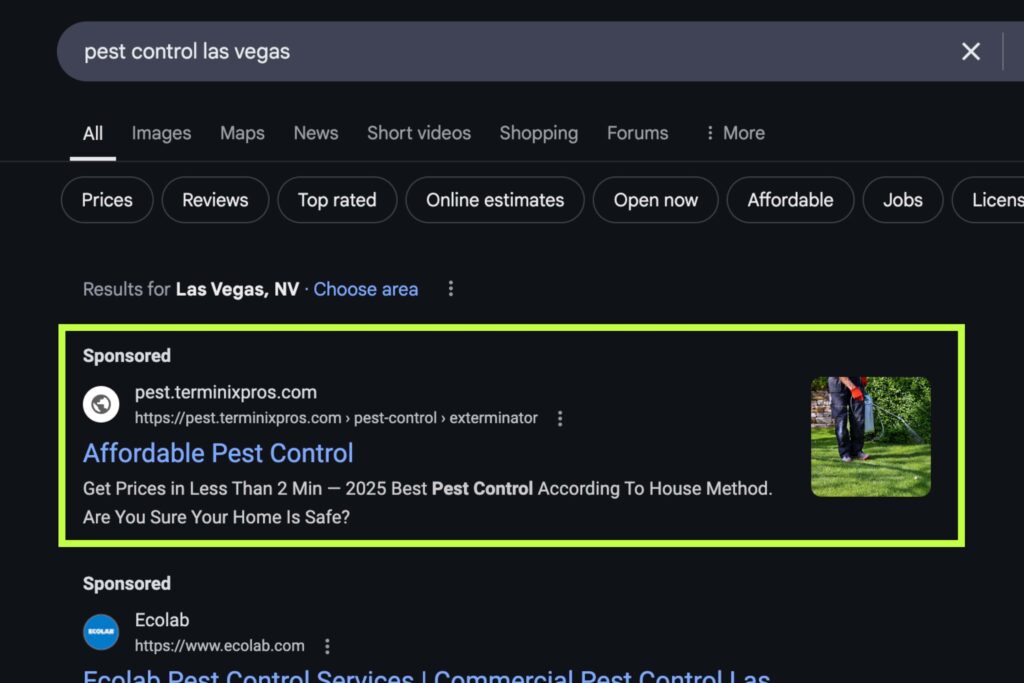
If you offer services like ant extermination, rodent control, or wasp nest removal, your ideal customers aren’t scrolling social media — they’re searching Google with urgent intent.
Think about it:
- A homeowner types “rat removal near me” after seeing something scurry under the fridge.
- A landlord needs “bed bug exterminator fast” before a new tenant moves in.
- A business searches for “commercial pest control service Las Vegas” after a health inspection warning.
With Google Ads, you can show up at the exact moment they’re ready to hire. Unlike SEO, which takes time to build, PPC gives you immediate visibility in local search results — especially for high-value keywords that show buyer intent.
When done right, Google Ads deliver:
- Fast results – New leads within days, not months.
- High-quality calls and form submissions – From people who are ready to book.
- Measurable ROI – You can track exactly which ad, keyword, and landing page brought in each customer.
The challenge? Getting it right without wasting time or money — which we’ll dive into next.
Why Most Pest Control Companies Waste Money on PPC
Running ads is easy. Running ads that actually generate booked jobs? That’s where most pest control businesses lose thousands without realizing it.
Here’s what typically goes wrong:
1. Broad, Unqualified Keywords
Too many campaigns target vague terms like “pest control” or “exterminator” without narrowing down by service or location. This leads to clicks from people:
- Outside your service area
- Looking for DIY solutions
- Comparing 10 companies without much urgency
If your ad shows up for “how to get rid of ants naturally,” you’re paying for traffic that will never convert.
2. Sending Traffic to a Generic Website
Clicking an ad and landing on your homepage is like walking into a hardware store and being asked to browse the entire building.
People searching for help with “wasp removal near me” want one thing: to know you can solve their problem and how to contact you right now.
What works better:
A focused landing page with:
- The specific service they searched for
- Clear pricing or free quote offer
- Call now + contact form
- Reviews and trust signals
We dive deeper into this in our post on web design for pest control companies — be sure to check it out.
3. No Call Tracking or CRM Integration
You might be getting leads without even knowing it — especially if your ads are driving phone calls.
Without call tracking, you can’t see which ads are working.
Without a CRM, you can’t follow up on missed calls or track who booked and who didn’t.
Most pest control businesses are running ads blind.
Want to fix that? Our CRM for pest control tracks every lead and automates follow-up so no opportunity slips through the cracks.
4. Zero Follow-Up = Lost Revenue
Did you know that 80% of sales happen after the first touchpoint?
If a customer fills out a form and doesn’t hear back in minutes, they’re already calling your competitor.
With the right automation, every lead gets a text or email instantly — even if you’re up a ladder or dealing with a crawlspace infestation.
Bottom line: Google Ads can absolutely grow your pest control business — but not if your strategy is built on guesswork, generic websites, and broken follow-up. In the next section, we’ll walk through the exact steps to set up a high-converting PPC campaign for your business.
How to Set Up a High-Converting Google Ads Campaign for Pest Control
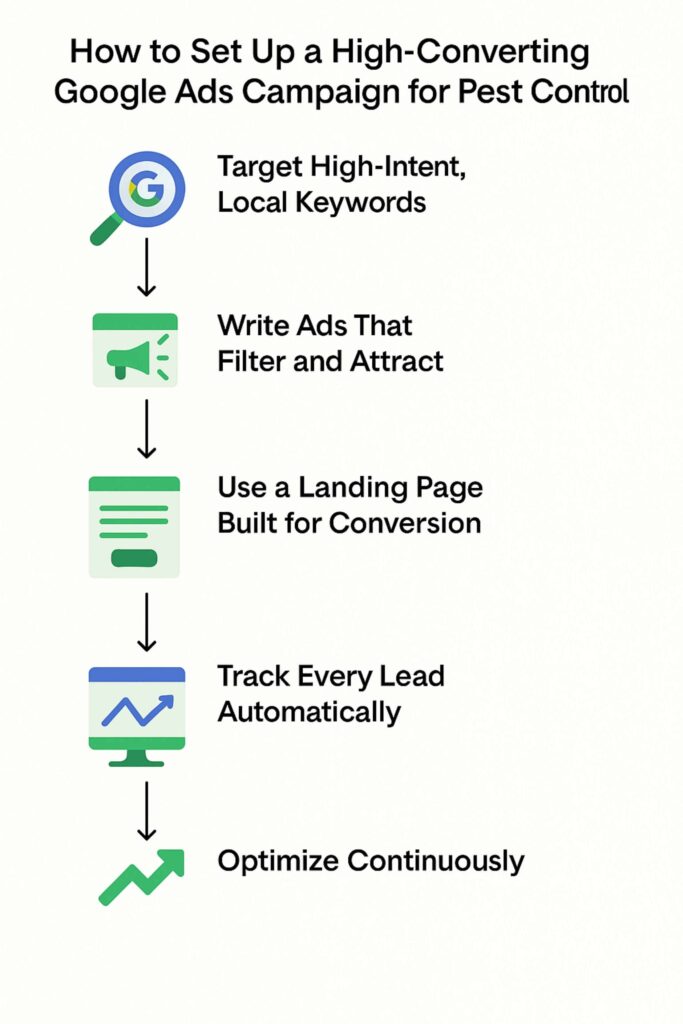
Getting results from Google Ads isn’t about spending more — it’s about building a system that attracts the right leads and turns them into booked jobs. Here’s how to do it step by step:
1. Target High-Intent, Local Keywords
Skip the generic terms. Focus on phrases that signal someone is actively looking for help now and is located within your service area.
Examples:
- “rat control [your city]”
- “bed bug exterminator near me”
- “get rid of wasps fast [your region]”
Use exact match or phrase match to filter out irrelevant traffic — no more paying for clicks from people halfway across the country or just looking for advice.
2. Write Ads That Filter and Attract
Good ads don’t just get clicks — they attract the right ones.
Include:
- Location (e.g., “Serving Phoenix & Nearby Areas”)
- Service-specific offers (“24/7 Emergency Pest Removal”)
- Real differentiators (“Certified. Guaranteed. Family-Safe.”)
Pro tip: Use ad extensions to boost visibility — especially call buttons and sitelinks to specific services.
3. Use a Landing Page Built for Conversion
This is non-negotiable. Every ad should lead to a dedicated page that:
- Matches the service being advertised
- Has a clear call-to-action (book now, request a quote, call instantly)
- Loads fast and works flawlessly on mobile
Don’t send people to your homepage or a contact form buried three clicks deep. Every second of friction = lost revenue.
We break this down in detail in our post on pest control web design best practices.
4. Track Every Lead — Automatically
Once the ads are running, you need to know what’s working.
- Use dynamic call tracking to see which ads triggered each phone call
- Connect form submissions to a CRM
- Set up automated notifications so no lead is ever missed
This is where most campaigns fall apart — and where our all-in-one system stands out. Every ad, call, and form is tracked in one place, with automated follow-up to increase your close rate.
5. Optimize Continuously (Without Guesswork)
The best campaigns get better over time. Once you have data coming in, test:
- New ad headlines
- Different service pages
- Location-specific offers
But skip the guesswork. Focus on data-driven decisions tied to actual results — not just impressions or clicks.
PPC vs SEO for Pest Control: Which Is Better?
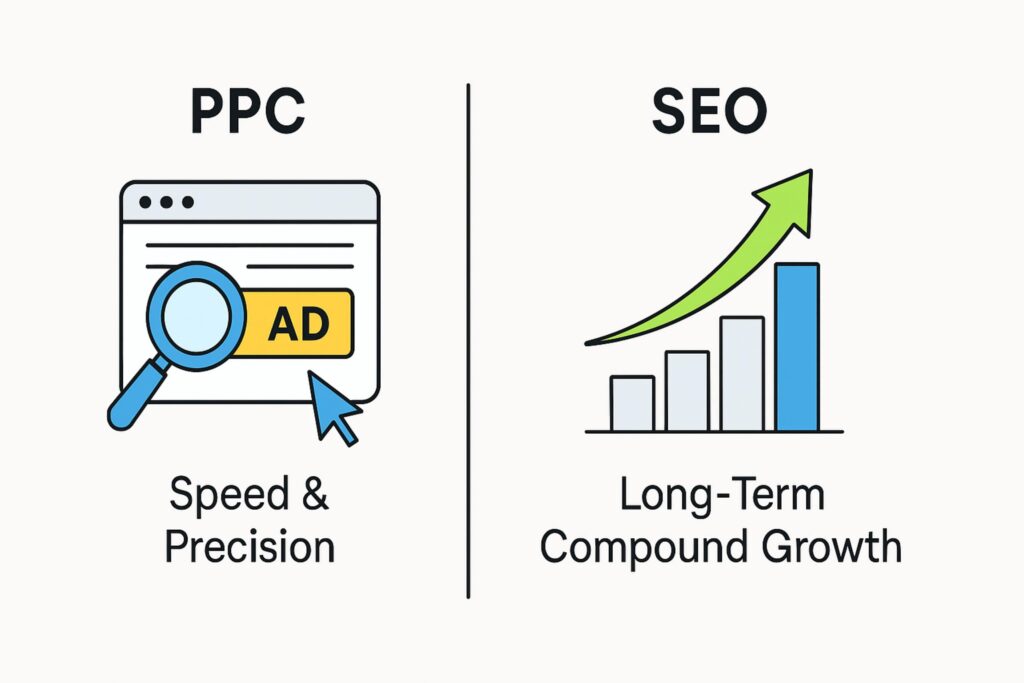
When it comes to online marketing, most pest control companies find themselves asking the same question:
“Should we focus on paid ads or SEO?”
The answer isn’t either-or — it’s about understanding the difference in payoff and how to combine both for maximum growth.
PPC (Pay-Per-Click): Speed & Precision
Google Ads are your fast lane. You choose the keywords, control the budget, and appear instantly when someone searches for your service.
- Great for: Immediate lead generation, seasonal services, and emergency response
- Downside: You stop paying, you disappear
PPC is best for businesses that want results this month, especially when paired with conversion-focused landing pages and automated lead handling.
SEO (Search Engine Optimization): Long-Term Compound Growth
SEO takes time, but it builds a foundation that brings in free, high-intent traffic month after month.
- Great for: Building brand trust, reducing customer acquisition costs, and dominating local rankings
- Downside: Slower to start, requires consistency and technical expertise
Over time, strong SEO can reduce your dependence on paid ads — but only if it’s done strategically and tailored to how pest control customers search.
The Smartest Strategy? Do Both — The Right Way
Your PPC campaigns bring in leads today.
Your SEO content ensures you’re found tomorrow.
Together, they create a sustainable growth engine — one that feeds your pipeline from multiple angles, builds authority, and keeps you top-of-mind in your service area.
Want to see what a full-funnel strategy looks like for a pest control company?
Read our SEO guide for pest control businesses for a step-by-step breakdown.
Next up: let’s talk about when it actually makes sense to hire a PPC agency — and how to avoid the traps that waste your money.
When to Hire a PPC Agency (And What to Watch Out For)

Running your own ads might seem simple at first — until you’re knee-deep in keyword match types, Quality Scores, and a dashboard that looks more like a spreadsheet than a solution.
That’s when many pest control businesses start looking for outside help.
But hiring a PPC agency doesn’t guarantee better results. In fact, if you choose the wrong one, it can become just another monthly expense with no measurable ROI.
Here’s how to know if bringing in help makes sense — and what red flags to avoid.
When It Makes Sense to Get Help
You’re a pest control expert — not a full-time digital marketer. It may be time to hire if:
- You’ve run ads but aren’t sure what’s working (or if anything is)
- You don’t have time to manage campaigns or respond to every lead
- You’re spending more than $500/month on ads and not seeing consistent bookings
- You want to scale your business but don’t want to learn Google Ads from scratch
This is where expertise and systems make a difference — not just running ads, but converting them into revenue.
What to Watch Out For in a PPC Agency
Not all agencies are built for service businesses — and very few understand the pest control space. Here’s what to avoid:
- Generic strategies: If they can’t explain how their plan is tailored to pest control, it’s not.
- No landing page strategy: Sending clicks to your homepage is a waste of money.
- No integration with your lead pipeline: If they don’t ask how you track leads or follow up, they’re not thinking about your results.
- Pretty reports, no transparency: If they focus on vanity metrics like impressions or clicks without showing booked jobs, run.
A Better Alternative: Our All-In-One Growth System
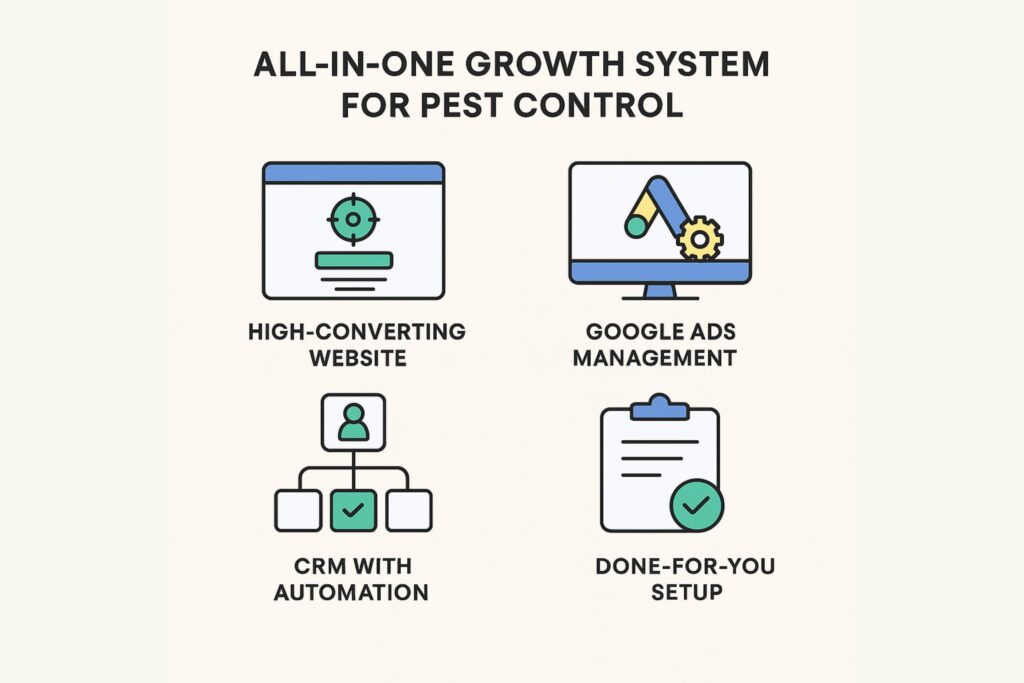
If you’ve ever felt like you’re stitching together different tools, agencies, or platforms just to get leads — you’re not alone. Most pest control business owners we work with are juggling a website that doesn’t convert, ads that aren’t being tracked, and a CRM that either doesn’t exist or doesn’t do what it should.
We built our all-in-one growth system to change that — by giving you a fully integrated solution that’s designed to deliver results, not just reports.
What’s Included in the Growth System
Instead of hiring a PPC agency, a freelance designer, and a marketing consultant — and still wondering why your phone isn’t ringing — our system combines everything you need to grow, in one place:
1. A High-Converting Website (Built for Ads)
Not a template. Not a generic homepage.
You get a clean, fast-loading website designed specifically to convert ad clicks into booked jobs.
- Mobile-first layout
- Clear calls to action
- Trust-building content (reviews, guarantees, service highlights)
2. Google Ads Management That Drives Local Leads
We don’t just run campaigns. We build tightly targeted, location-specific ads that reach people who are ready to book.
- Expert keyword targeting + ad copywriting
- Ongoing optimization for better ROI
- Call tracking and lead attribution tied to real outcomes
3. A CRM That Automates the Follow-Up
Leads don’t just land in your inbox — they get captured, tracked, and followed up with instantly.
- Missed-call text back
- Email and SMS automations
- Appointment confirmations and review requests
- Visual pipeline tracking so you know what’s converting
No leads slipping through the cracks. No guessing.
4. Full Setup Done For You — With a Focus on Results
We handle the implementation from start to finish. You get a professional presence, a connected backend, and a lead generation system that runs like clockwork.
No learning curve. No cobbling things together. Just a proven framework, built for pest control businesses that are ready to grow.
Built for Businesses That Are Serious About Growth
This system wasn’t designed for hobbyists. It’s for business owners who are ready to step into the next phase — where their website, ads, and operations all work together to drive revenue, not just activity.
When you’re ready to stop piecing things together and start operating like a business that wins in your market, we’re ready to help you get there.
Book a strategy call today to see how our system can help you attract better leads, convert more customers, and stay ahead of your competition.
FAQ: PPC for Pest Control
1. How much should a pest control company budget for Google Ads?
Most pest control businesses start seeing consistent results by spending at least $500 to $1,500 per month. The key is targeting high-intent local keywords, using a conversion-focused landing page, and tracking leads properly to maximize ROI.
2. What keywords should pest control companies target in Google Ads?
Focus on service + location keywords that show urgent intent, like “termite treatment [city],” “wasp removal near me,” or “bed bug exterminator fast.” Avoid broad terms like “pest control” without local targeting, as they lead to low-quality clicks.
3. Why is sending Google Ads traffic to my homepage a mistake?
Homepages are too general and cause visitors to bounce. A dedicated landing page matching the service they searched for — with clear calls to action, trust signals, and fast load times — dramatically increases the chances of getting booked.
4. How do I track which Google Ads are actually bringing in pest control jobs?
Use dynamic call tracking and connect your forms to a CRM. This lets you see exactly which ad and keyword led to each call or booking, automate follow-ups, and avoid wasting money on ads that aren’t converting.
5. Is it better to do PPC or SEO for pest control marketing?
Both together work best. PPC brings in leads quickly by showing ads to people ready to hire now, while SEO builds long-term organic visibility and trust. A combined strategy creates faster growth and more sustainable results.