Paid Ads & Lead Generation
PPC for Construction Companies: How to Get High-Quality Leads on Autopilot

How to Get High-Quality Leads on Autopilot
If you’re a construction or remodeling company looking to grow, you’ve probably tried everything from word-of-mouth to Facebook posts — maybe even boosted a post or two. But if you’re not running PPC ads (like Google Ads), you’re leaving money on the table.
The truth is, high-paying construction jobs often go to the companies that show up first. That’s exactly what PPC does — it puts you at the top of Google right when people are searching for services like yours. But here’s the kicker: without the right setup, PPC can feel like burning money.
This guide is for construction and remodeling companies who are tired of chasing leads and want a reliable, automated way to fill their calendar with high-quality clients. We’ll break down exactly how to make PPC work for you — even if you’ve never run a campaign before.
Bonus: If you’re already running ads but not seeing results, you’ll learn the most common mistakes contractors make — and how to fix them fast.
Why PPC Works So Well for Construction & Remodeling Companies
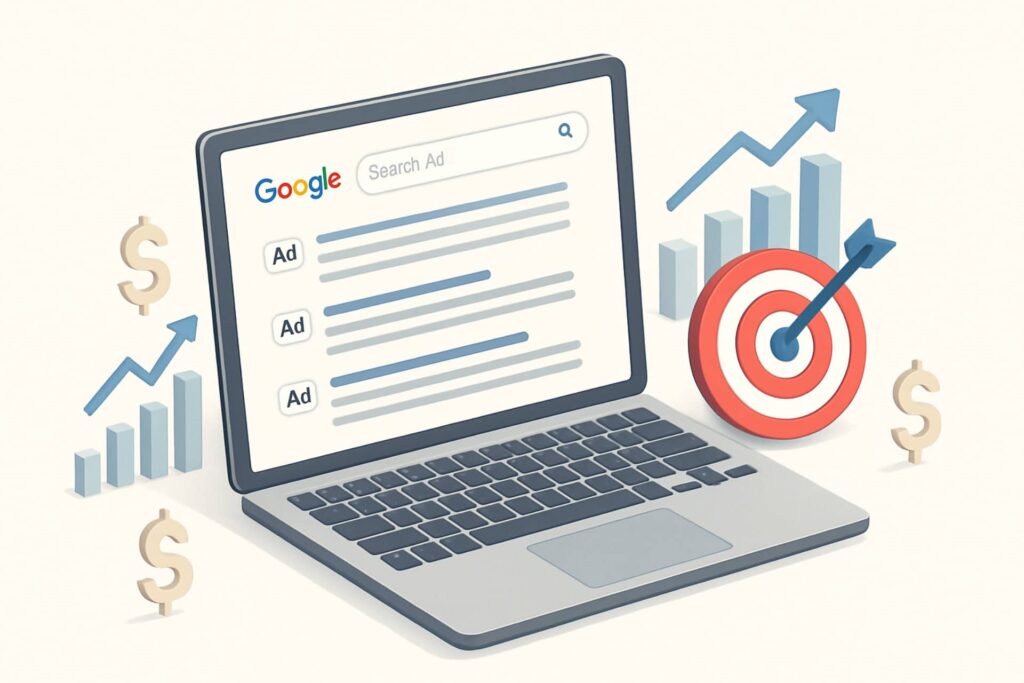
Let’s start with the basics. PPC stands for pay-per-click, and in most cases, it refers to Google Search Ads — the ones that show up at the top of search results when someone types in “kitchen remodeler near me” or “custom home builder in [your city].”
Here’s why PPC is so powerful for contractors:
1. You Reach People With Real Buying Intent
SEO and social media have their place — but Google Ads targets people who are actively searching for your services. These aren’t casual browsers. They’re ready to book.
2. You Control the Budget and Targeting
Unlike print or radio, PPC lets you target by:
- ZIP code or service area
- Keywords (like “deck builder” or “bathroom remodeling”)
- Device (so you can prioritize mobile users)
You also set the budget. Even with a few hundred dollars a month, you can generate quality leads — if the campaign is set up right.
3. It’s Fast
SEO takes time. PPC gets you leads this week. For companies looking to fill a few open slots next month, that speed is game-changing.
Want to compare SEO vs PPC in more detail? Check out our breakdown of SEO vs Paid Ads for Home Services →
Common PPC Mistakes Contractors Make (and How to Avoid Them)

Running Google Ads isn’t just about flipping a switch and watching leads pour in. For construction and remodeling companies, a poorly structured campaign can mean wasted budget and zero results. Here are some of the biggest pitfalls — and what to do instead.
1. Lumping All Services Into One Campaign
Many contractors set up one generic campaign with broad keywords like “remodeling services.” The problem? These terms attract a wide range of clicks — not all of them relevant.
Fix: Create separate ad groups for each service you offer (e.g., kitchen remodels, basement finishing, deck construction). This makes your ads more specific and improves click-through rates.
2. Sending Traffic to a Generic Homepage
A homepage isn’t a landing page. It has too many distractions and doesn’t guide visitors toward taking action. You need a focused path.
Fix: Send ad traffic to a dedicated landing page built for conversions — one that clearly explains your service, includes social proof, and makes it easy to book a consultation.
Pro tip: Your landing page should have one goal — get the visitor to call, fill out a form, or book a time. No fluff, no distractions.
3. Ignoring Lead Follow-Up
Most construction companies don’t have an issue getting leads — they have an issue responding quickly enough. Waiting even one hour can kill your chances of closing the deal.
Fix: Automate your follow-up process. Use a CRM that sends instant text responses, voicemail drops, and auto-reminders so no lead slips through the cracks. (Related: Lead Follow-Up Automation for Contractors)
4. Not Using Negative Keywords
If you’re paying for clicks on terms like “DIY remodeling ideas” or “remodeling jobs near me,” you’re not attracting customers — you’re attracting job seekers or information hunters.
Fix: Build a strong negative keyword list (e.g., “cheap,” “free,” “template,” “how to”) to filter out irrelevant searches and protect your budget.
When these issues are addressed, PPC transforms from a gamble into a predictable growth channel. In the next section, we’ll walk through how to structure your campaign from scratch — the right way.
How to Structure a High-Converting PPC Campaign for Contractors
Getting your PPC campaign to perform isn’t just about choosing the right keywords — it’s about building a system that turns search intent into booked jobs. Here’s how to set up a campaign that actually works.
1. Start With One Service, One Area, One Goal
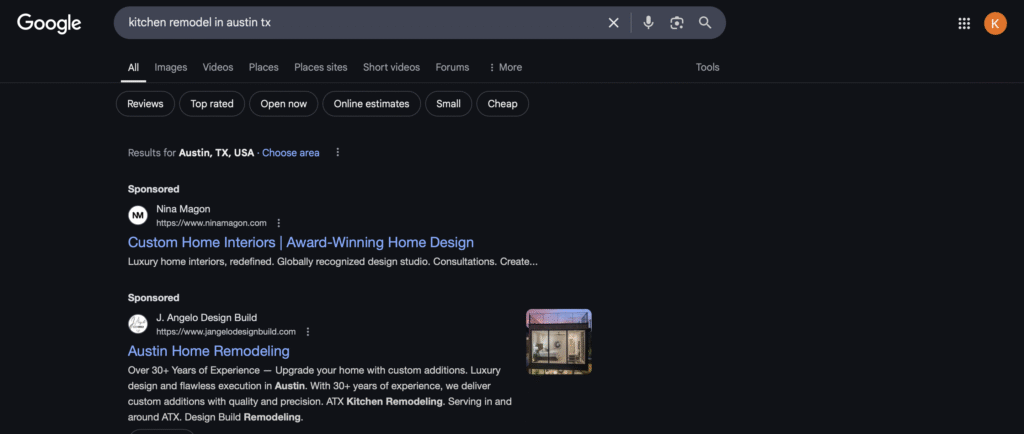
Too many contractors go too broad too soon. Instead, start with your most profitable service in your best-performing area — like kitchen remodeling in Dallas or deck building in Austin.
Why it works: This approach gives you cleaner data, tighter targeting, and faster wins. You can always scale later once the first campaign is profitable.
2. Build Tightly Themed Ad Groups
Each ad group should focus on one specific intent. For example:
- “Bathroom Remodeling”
- “Kitchen Renovation”
- “Home Additions”
Each ad group should have:
- Keywords closely related to the theme
- Ads that speak directly to those services
- A landing page tailored to that exact offer
3. Write Ads That Address Pain and Promise Outcomes
Don’t waste precious headline space with generic claims like “High-Quality Service.” Your prospects already expect quality. Focus on what they care about:
- Pain: “Tired of missed deadlines and no-shows?”
- Promise: “Get your remodel done on time — and on budget.”
Include trust signals like licensed & insured or 20+ years of experience, but keep it sharp. And always have a clear CTA like Book Your Free Estimate or Call Now.
4. Optimize for Mobile From the Start
Most people searching for contractors are on their phones. That means your entire funnel — from ad copy to landing page to booking — needs to load fast, look great, and make it easy to take action on mobile.
At a minimum, your landing page should have:
- Click-to-call button
- Simple contact form
- Trust badges (BBB, reviews, insurance logos)
Want to see what a great mobile-first landing page looks like? Check out our Web Design for Contractors breakdown →
5. Track Every Click, Call, and Conversion
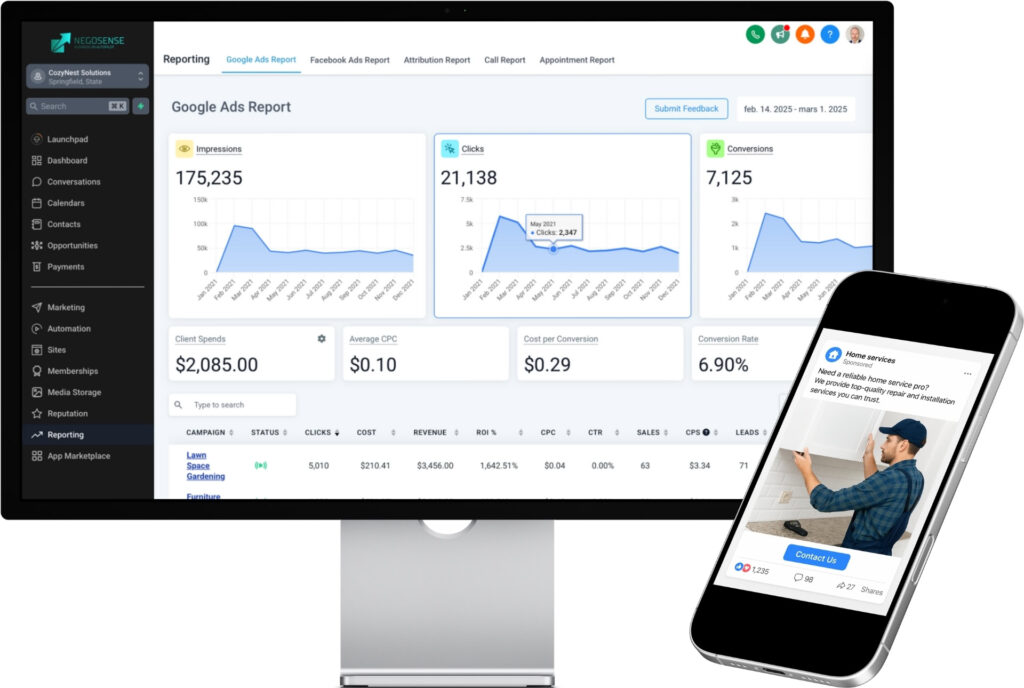
If you’re not tracking results, you’re flying blind. Use tools like:
- Call tracking numbers
- UTM parameters
- Conversion tags in Google Ads
And ideally, all of that data should feed into your CRM so you know exactly which leads came from which ads — and which jobs are tied to which campaigns.
Not sure how to connect everything? Our all-in-one system handles this for you. From ad click to booked job, it’s all tracked and automated behind the scenes.
Landing Pages That Actually Convert Visitors Into Jobs
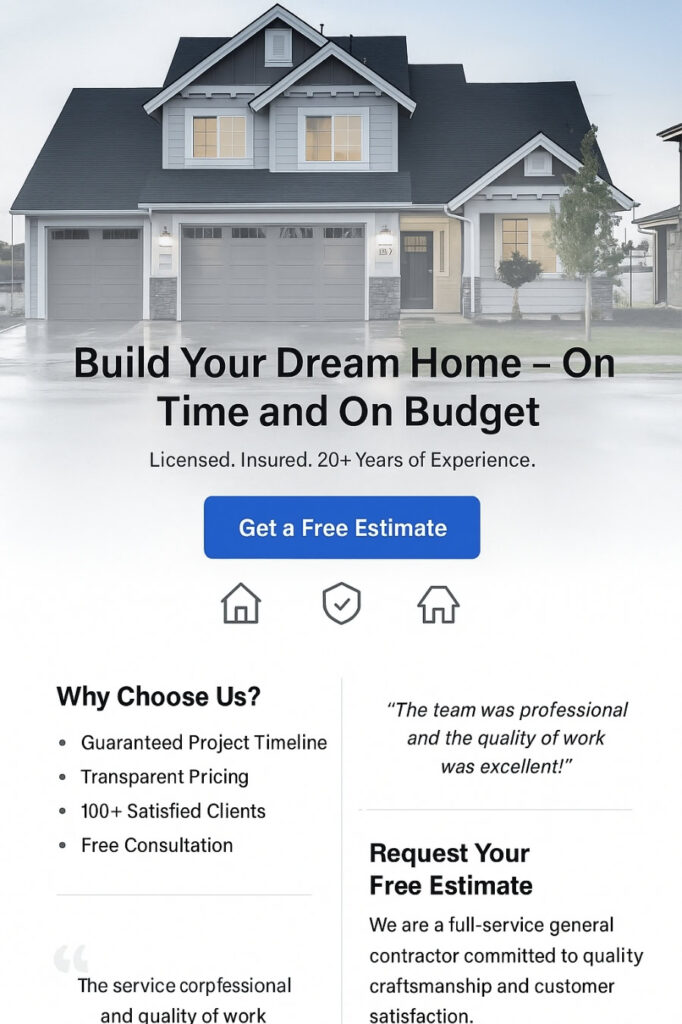
You’ve got the ad. You’re getting clicks. But if those visitors land on a page that doesn’t convince them to take action, you’re paying for nothing. The landing page is where interest becomes opportunity — and most contractor websites simply aren’t built for that.
Here’s how to build a landing page that turns clicks into qualified leads.
1. Match the Message
Your landing page needs to mirror the promise you made in the ad. If your ad says “Free Kitchen Remodel Estimate,” your page should open with exactly that — not a general pitch about your company.
Consistency builds trust. Disconnected messaging causes drop-off within seconds.
2. Use a Clean, Skimmable Layout
Contracting prospects aren’t here to read a novel. They want to quickly see:
- What you offer
- Why they should trust you
- How to get in touch
Keep your layout simple: headline → benefit → proof → call to action.
3. Include Social Proof and Trust Triggers
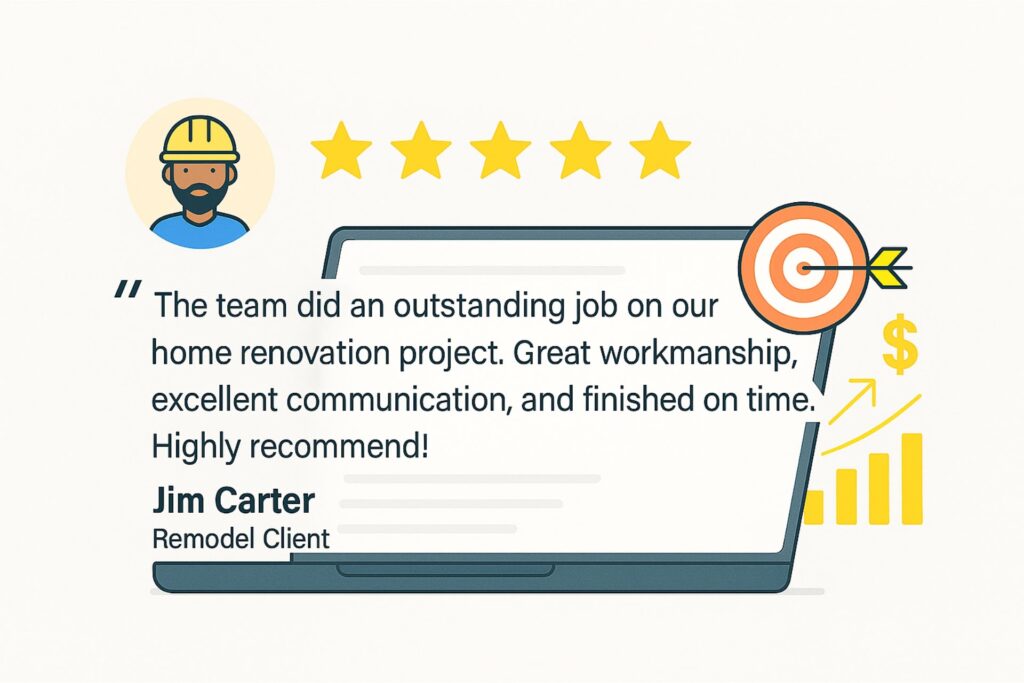
Before someone books a call or fills out a form, they want to know you’re legit. Include:
- Customer testimonials
- Photos of completed projects
- Logos (BBB, certifications, years in business)
If you don’t have reviews yet, use a “trusted by X homeowners in [your city]” line or similar credibility markers.
4. Minimize Distractions
No menus. No outbound links. No social icons. A landing page is not your main website — it’s a focused sales tool.
Every element should guide the visitor toward one thing: taking the next step. That could be calling you, filling out a form, or booking a time.
Want to see a high-performing layout? Our CRM comes with industry-specific landing page templates designed to convert traffic into booked jobs — with built-in tracking and automations. Explore CRM features.
5. Make Contact Effortless
One of the top reasons visitors bounce? Friction. If your contact form is too long or your phone number isn’t clickable on mobile, you’re losing leads.
Stick to:
- Name
- Phone/email
- Short message or dropdown (“What project do you need help with?”)
Bonus points if your form triggers an instant follow-up — which brings us to the next key topic: what happens after someone hits ‘submit.’
Why an All-in-One System Beats DIY Campaigns
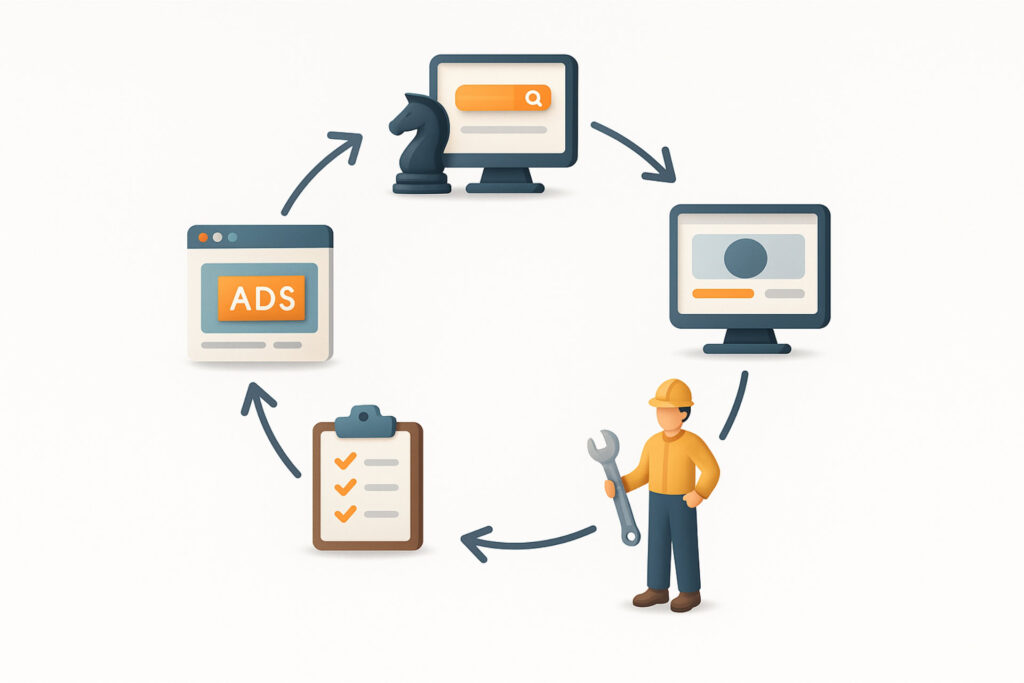
Running ads is just one piece of the puzzle. If your lead flow breaks down after the click — whether from slow follow-up, clunky tools, or scattered systems — you’re not just missing opportunities, you’re paying to lose them.
That’s why contractors who want consistent growth are moving away from duct-taped tools and toward integrated systems that handle everything from lead capture to closed deal.
1. Everything Works Together — Without You Babysitting It
Most contractors are juggling five different platforms: a website builder, a call tracker, a CRM (if they even have one), plus spreadsheets and inboxes.
Our all-in-one system replaces all of that.
- Visitors click your ad →
- Land on a high-converting page →
- Fill out a form or call →
- The system responds instantly and logs the lead →
- You get notified — and your pipeline stays full
No copy-pasting. No delays. No missed leads.
2. Built-In Follow-Up That Closes More Jobs
The reality? The contractor who follows up first usually gets the job. Our system makes sure you’re always the first to respond — even if you’re on a job site or with another client.
- Instant text reply when a lead comes in
- Automated follow-up sequence via SMS/email
- Call reminders so you never forget to follow up
- Pipeline tracking so you know exactly where every lead stands
3. Real-Time Insights Without Guesswork
You don’t need to be a marketing expert to know what’s working. The dashboard shows you:
- How many leads you got this week
- Where they came from
- Which ads are performing best
- How many turned into paying jobs
No spreadsheets. No guessing. Just actionable data that helps you grow faster.
4. More Than Ads — It’s a Growth Engine
This isn’t just about running ads. It’s about building a system that brings in new leads, responds to them instantly, nurtures them automatically, and keeps your calendar full.
If you’re ready to stop wasting time on tech that doesn’t talk to each other and start using a system built specifically for construction and remodeling companies, book a free walkthrough of our PPC campaigns.
What to Expect in the First 30, 60, and 90 Days of a Well-Structured PPC Campaign

If you’re new to Google Ads — or have tried it before without success — it’s important to set the right expectations. Results don’t happen overnight, but they do build fast when you follow a proven process.
Here’s a realistic timeline of what happens when your campaign is built and managed the right way.
Days 1–30: Foundation + First Leads
- Campaigns go live with tightly targeted keywords and landing pages
- You start getting traffic within 24–48 hours
- The first leads begin trickling in — usually a mix of phone calls and form submissions
- Early data helps us spot what’s working and where to tweak
- Your follow-up system kicks in, capturing and responding to every inquiry
You’re laying the groundwork here. This is where we see quick wins and set the stage for consistent performance.
Days 31–60: Optimization + Better Lead Quality
- Keyword performance is reviewed and refined
- Ads are split-tested to improve click-through and conversion rates
- Negative keywords are expanded to filter out unqualified traffic
- Your cost per lead begins to drop, and quality goes up
- You may begin closing your first jobs from campaign leads
This is where the system starts to find its rhythm. Every dollar you spend now works harder than it did in week one.
Days 61–90: Momentum + Predictable Pipeline
- Best-performing ads and landing pages are scaled
- Retargeting ads can be layered in to re-engage site visitors
- Your CRM has a growing list of leads — and follow-up automations are keeping them warm
- You begin to see a reliable flow of new inquiries each week
- Revenue starts to compound as closed jobs catch up with the ad spend
By now, this is more than a campaign — it’s a growth system. One you can count on to keep your crew busy and your schedule booked out.
Ready to see how this works in your market?
We’ll build the full system for you — including the website, ads, automations, and tracking — so you can focus on closing jobs, not chasing leads.
Book a free strategy call →
Explore how our all-in-one system works →
Stop Gambling on Ads — Build a System That Grows With You
Running ads without a system is like pouring water into a leaky bucket. You might get leads, but without fast follow-up, a solid website, and clear data, most of them slip through the cracks.
PPC is one of the fastest ways to grow your construction or remodeling business — but only if every part of the journey is optimized. That means:
- Ads that target the right people
- Landing pages that convert clicks into calls
- Automations that respond instantly
- A CRM that tracks everything in one place
That’s exactly what we build for our clients. Negosense is a digital marketing agency for home service contractors. We don’t just run ads — we build a full lead generation engine designed to grow with you.
Here’s what you can do next:
Book a free strategy session — we’ll show you what this could look like for your business, no hard pitch.
Want to learn more? Check out these related resources:
- Web Design for Contractors: What Actually Converts
- CRM for Remodeling Companies: Automate Your Sales Pipeline
- Lead Generation Strategies for Construction Businesses
You don’t need to become a marketing expert. You need a system that gets results — and a team that makes it run without you.
Let’s build it together.
Frequently Asked Questions: PPC for Construction Companies
What is PPC and how does it work for construction companies?
PPC (pay-per-click) is an online advertising model where you pay only when someone clicks on your ad. For construction companies, this typically means running Google Search Ads that appear when someone searches for services like “home addition contractor near me” or “kitchen remodeler in [your city].” You bid on these search terms, and when someone clicks your ad, they’re taken to your landing page — ideally one that’s optimized to convert them into a lead.
Is PPC worth it for small construction companies?
Absolutely — if it’s done right. PPC allows small and mid-sized construction companies to compete with bigger players by showing up at the top of search results. With smart targeting and a high-converting landing page, even a modest ad budget can bring in consistent, qualified leads.
How much should a construction company spend on PPC?
It depends on your market, competition, and goals. A typical starting budget is $500–$1,500/month, but what matters more is how well that budget is managed. A tightly structured campaign with optimized targeting can generate more leads at a lower cost per click. What you don’t want is to overspend on poorly set up campaigns — that’s where many contractors go wrong.
How long does it take for PPC to work for construction services?
Most well-built campaigns start generating leads within a few days. That said, PPC for construction companies becomes most effective between 30–90 days, after initial testing, optimization, and scaling based on real-world data. It’s not a magic switch — it’s a system that compounds over time.
What makes PPC for construction companies different from other industries?
Construction and remodeling services are high-ticket and often involve longer decision cycles. That means your ads need to:
- Target high-intent searchers
- Build trust quickly (with reviews, credentials, and guarantees)
- Capture leads and follow up immediately
A one-size-fits-all campaign won’t cut it — your PPC strategy should be customized for the construction industry’s unique sales process and client expectations.
Can I run PPC campaigns myself, or should I use a system like yours?
You can run ads yourself — but most contractors don’t have the time or tools to manage campaigns, create landing pages, track conversions, and follow up fast enough to win the job. Our system is built to handle the full pipeline: from ad click to booked project, with automation, reporting, and support baked in. You stay focused on the work — we keep the leads coming in.
Articles Related to PPC for Construction Companies
Construction Services
- SEO for Construction Companies: Build Your Online Presence
- How to Get Quality Contractor Leads in 2025
- PPC for Construction Companies
- Web Design Tips for Construction Companies
- Best CRM for Construction and Remodeling (2025)
- How to Grow Your Construction Business in 2025