Paid Ads & Lead Generation
Plumber Ads: Run Profitable Campaigns in 2025
When plumbing problems strike, people don’t browse—they search. And if your business isn’t showing up, you’re missing out on easy revenue. That’s why plumber ads are essential in 2025.
This guide breaks down how to advertise your plumbing business the smart way—covering platforms that actually work, how to avoid wasted spend, and the tools that turn clicks into booked jobs.
If you’re serious about getting more calls and maximizing your ad budget, you’re in the right place.
Why Ads Matter for Plumbers
For most plumbing businesses, referrals and word-of-mouth aren’t enough to create consistent, scalable growth. You need leads coming in every day, not just when someone happens to pass along your number. That’s where paid advertising becomes essential.
1. It gets you in front of people who are ready to book
When someone’s dealing with a clogged drain, no hot water, or a leaking pipe, they don’t research for hours — they search, skim, and call the first trustworthy option they find. Plumber ads on Google or local directories put you in that decision zone instantly.
2. It levels the playing field
You might not have the biggest company or the most reviews yet. But with smart ad targeting, you can appear right alongside (or above) your biggest competitors — often with a smaller budget.
3. It gives you control and data
Unlike SEO or organic social media, which can feel like a guessing game, advertising gives you:
- Immediate visibility
- Clear tracking (what ads led to what jobs)
- Scalable results — once you find a winning formula, you can double down
4. It fills gaps in your calendar
Busy season or slow season, ads give you a switch you can turn up or down. Whether you’re launching a new service, covering cancellations, or trying to grow a new service area, well-placed plumber ad campaigns give you the flexibility to keep your team busy and your phone ringing.
If you’re looking to build a full marketing plan beyond just paid ads, check out our guide to digital marketing for plumbing businesses.
Types of Plumber Ads
There’s no one-size-fits-all ad strategy for plumbers — your results will depend on your local market, your services, and your budget. That said, the most effective plumber advertising strategies tend to fall into four main categories. Here’s what you need to know about each.
Google Ads / Pay-Per-Click (PPC)

If you’re only running one type of ad, Google Ads is where to start. Why? Because these ads show up exactly when someone searches for what you offer — “emergency plumber near me,” “clogged drain repair,” or “water heater installation.”
What works best:
- Service + location keywords: “toilet repair Chicago” or “24 hour plumber Austin”
- Ad extensions: Add a click-to-call button, service area, or trust badges
- Emergency-focused campaigns: These convert well and justify higher budgets
What to avoid:
- Broad keywords like “plumbing” without qualifiers
- Ignoring negative keywords (e.g., “DIY,” “free,” “classes”)
- Linking ads to your homepage instead of a dedicated landing page
PPC gives you high-intent traffic — but only if your setup is airtight. Poor targeting = wasted budget.
Social Media Ads
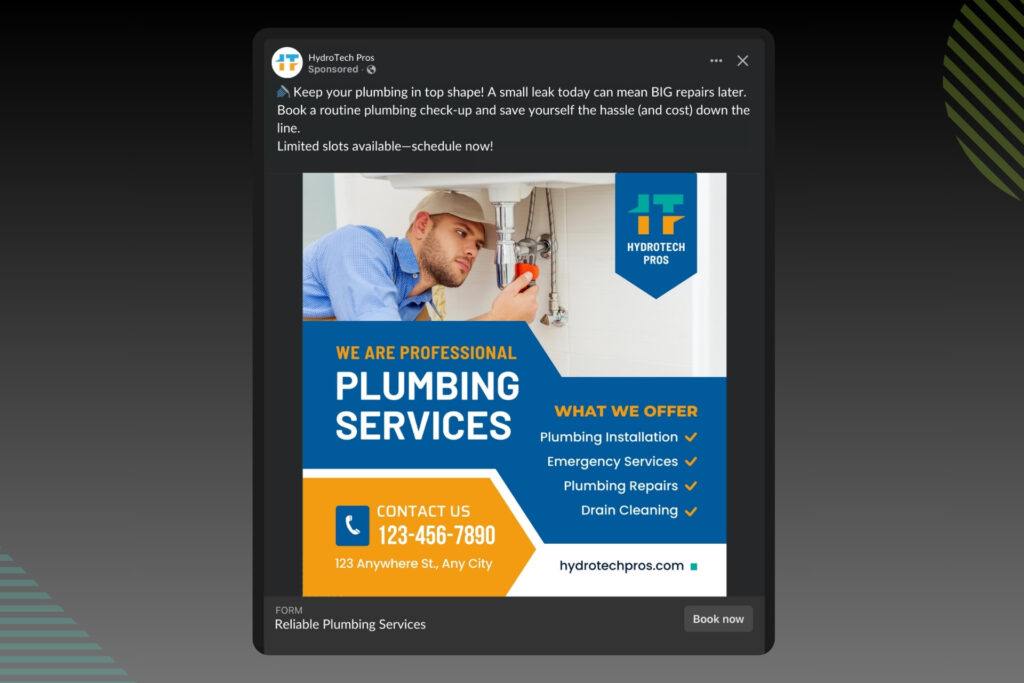
Facebook and Instagram Ads work best for brand awareness, seasonal offers, and follow-ups — not emergency services. But that doesn’t mean they aren’t worth running.
When to use them:
- Promoting spring checkups, winterizing services, or limited-time discounts
- Running retargeting ads to people who visited your site but didn’t call
- Sharing before-and-after photos or quick repair videos to build trust
Social media ad costs are generally lower than Google Ads, and they’re great for staying top-of-mind in your local market — especially when paired with organic posts or boosted reviews.
Local Directories & Listing Platforms
Homeowners still turn to platforms like:
These directories often show up in Google results — sometimes above local businesses. A paid listing can help you:
- Rank higher in their local search results
- Appear in “Top 10 Plumbers Near You” pages
- Get leads directly through their platforms
Tip: Listings work best when you already have strong reviews. If your profile looks empty or your response time is slow, paid listings won’t help much.
If you want to learn how ads fit into the bigger picture, check out our in-depth article on digital marketing for home services.
Traditional Offline Ads
Offline plumber ads still work — especially in tight-knit or older communities where digital saturation is lower.
Best offline ad options:
- Direct mail with coupons for common services
- Local newspaper ads targeting homeowners
- Billboards or yard signs in high-traffic neighborhoods
- Radio spots timed around commute hours
Use offline ads to support digital campaigns, not replace them. Always include a trackable phone number or promo code to measure ROI.
Each of these plumber ad channels can work — but you don’t need to use them all at once. Start with what fits your business, test it thoroughly, and expand based on performance.
Plumber Ad Types Comparison Table
| Ad Channel | Best For | Lead Quality | Speed of Results | Cost Range | Tracking & ROI | Pro Tip |
| Google Ads (PPC) | Emergency calls, high-intent leads | ⭐⭐⭐⭐⭐ | Immediate | $$–$$$$ per click | Easy with call tracking | Use location + service keywords for best ROI |
| Facebook / Instagram | Brand awareness, seasonal offers | ⭐⭐ | 1–2 weeks | $–$$ per 1,000 views | Moderate with pixel setup | Retarget website visitors with service promos |
| Local Directories | Passive leads, boosting local trust | ⭐⭐⭐ | 1–2 weeks | Fixed fee or pay-per-lead | Built-in tracking varies | Only pay if your reviews and profile are strong |
| Offline Ads | Local brand awareness, older markets | ⭐–⭐⭐ | Slow to medium | Varies widely | Hard to track | Include trackable phone numbers or coupon codes |
Best Practices for Creating Effective Plumber Ads
Running plumber ads is easy. Running ads that actually convert into booked jobs? That’s a different story.
Too many plumbing businesses throw money at ads without a clear strategy. They choose the wrong keywords, target too broadly, send traffic to a generic homepage, and never track what’s working. The result? Wasted budget and zero visibility into why.
This section breaks down the key components of an effective plumber advertising campaign — the exact steps that separate profitable campaigns from ones that burn through your cash.
Let’s start with what makes or breaks most campaigns on Google:
Keyword Research (for Google Ads)
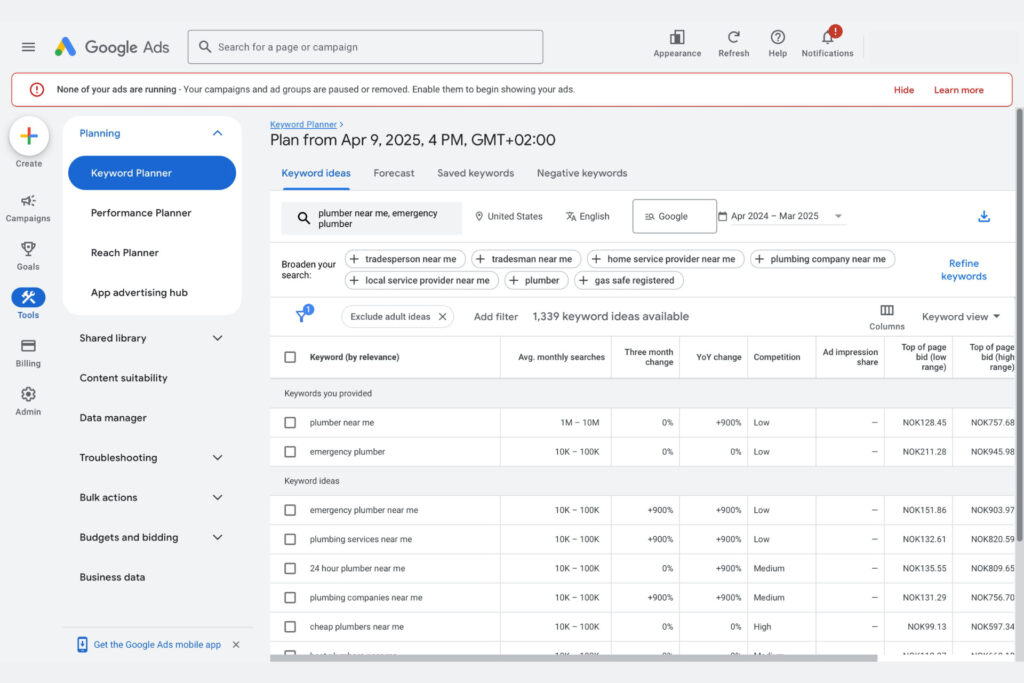
Plumber ads live or die by keyword targeting. If your keywords don’t match what high-intent customers are actually searching for, you’ll get the wrong clicks — or no clicks at all.
Here’s how to get it right:
1. Use Location + Service Pairing
You don’t want to rank for general terms like “plumber” — they’re too competitive and vague. Instead, go for location-specific, service-based searches. Examples:
- “emergency plumber Denver”
- “leak detection Houston”
- “toilet installation Chicago”
These show clear intent and attract customers who are ready to hire now.
2. Think Like a Homeowner
If your pipe burst at 8 PM, what would you Google? Probably something like:
- “24 hour plumber near me”
- “plumber open now”
- “fix broken pipe fast”
Use tools like Google’s Keyword Planner, Ubersuggest, or simply autocomplete results to build a list based on real search behavior.
3. Don’t Forget Negative Keywords
This is the most overlooked step. You want to exclude searches that bring in tire-kickers or irrelevant clicks. Add negatives like:
- “DIY”
- “plumbing school”
- “how to become a plumber”
- “free plumbing help”
Negative keywords protect your budget and keep the leads relevant.
4. Build Ad Groups by Service
Running ads for drain cleaning and water heater installation? Separate them into different ad groups — with their own ads and landing pages. This improves relevance, quality score, and click-through rate.
Clear & Concise Messaging
You have just a few seconds to convince someone to click — or call. Whether it’s a Google ad, a Facebook post, or a flyer on someone’s kitchen counter, your message needs to do three things fast:
- Say what you do
- Say why you’re different
- Tell them what to do next
Here’s how to apply that to plumber ads:
1. Lead with the pain point or solution
Examples that work:
- “Clogged Drain? We’ll Be There in 60 Minutes or Less”
- “No Hot Water? 24/7 Emergency Plumbing Available Now”
- “Trusted Local Plumber – Fast, Fair & Fully Licensed”
Skip generic lines like “Serving your community since 1998”. That belongs on your About page — not in an ad where every second counts.
2. Highlight what makes you different
If a homeowner is comparing five plumber ads, yours should stand out. Consider calling out:
- “Same-day service guaranteed”
- “Upfront pricing – no surprises”
- “Rated 5 stars by 200+ local customers”
Avoid empty phrases like “quality service” or “we care” — they don’t mean anything unless they’re backed up by real, specific benefits.
3. Use a strong call to action (CTA)
Tell them what to do next. Be direct. Examples:
- “Call now for a free quote”
- “Book online in 60 seconds”
- “Tap to call – plumbers standing by 24/7”
Pro tip: Match your CTA to your ad format. On Google Ads, use a call extension so they can tap and call immediately from mobile. On Facebook, link to a landing page with online scheduling.
Landing Pages
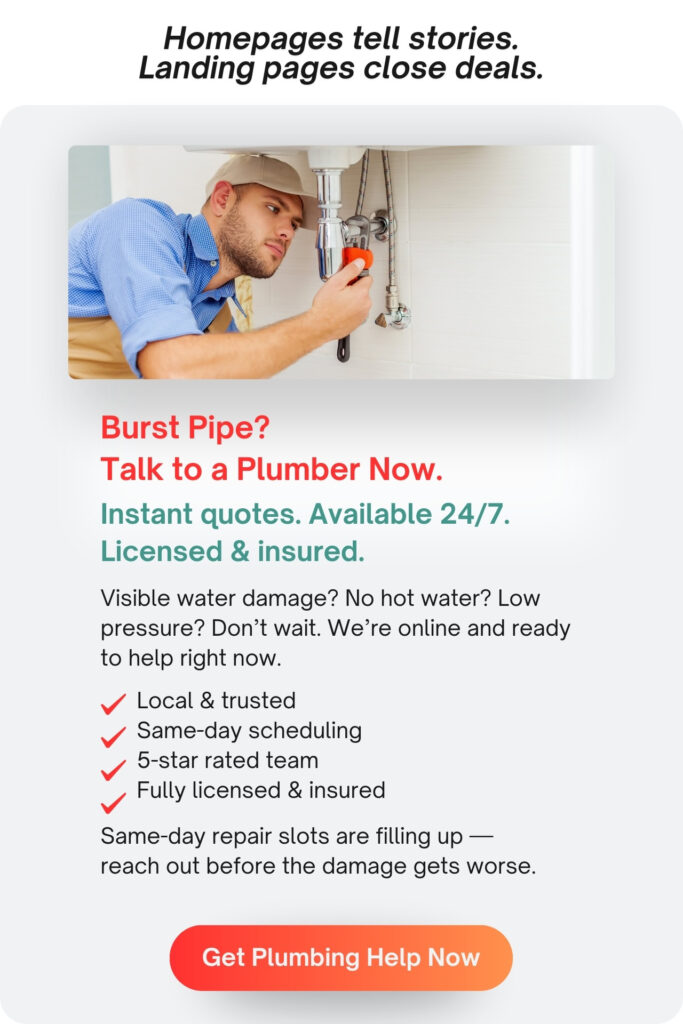
Clicking your ad is just step one. If that visitor lands on a messy homepage, or worse — a generic site with no clear next step — you’ll lose the lead. Fast.
That’s why every effective plumber advertising campaign needs a dedicated landing page. Think of it like a digital dispatcher: its only job is to convert that click into a booked job.
1. One page, one purpose
Each ad campaign should send traffic to a page that matches the offer or service being advertised.
Running ads for water heater repair? Don’t send them to your general plumbing page. Send them to a page focused on:
- Water heater repair options
- Your availability and pricing
- Trust factors (like reviews or certifications)
- A clear CTA (“Call Now” or “Book Online”)
2. Mobile-first design
Most plumbing leads come in from smartphones. If your landing page takes too long to load, or if the call button is buried, you’re bleeding leads.
Must-haves for mobile:
- Large “click-to-call” button near the top
- Fast load speed (under 3 seconds)
- Minimal scrolling required to take action
3. Strong CTA (above the fold)
“Above the fold” means visible without scrolling. Your CTA should be immediate and obvious.
Examples:
- Call Now
- Book a Service
- Get a Fast Quote
You can repeat the CTA further down the page, but don’t hide the first one. You’re not writing a novel — you’re solving a problem.
4. Add social proof + urgency
Your ad got their attention. Your landing page needs to close the deal.
Use:
- Reviews or testimonials (real or sourced from your Google Business Profile)
- Badges (e.g., licensed, insured, local)
- Urgency: “Same-day slots filling up fast” or “Now booking for today!”
Pro tip: Never run ads without landing pages. Sending traffic to your homepage is like running a billboard that points to a maze.
If you’re just getting started and don’t have a website yet, start here: how to create a free plumbing website that’s ready for ads.
Call Tracking & ROI
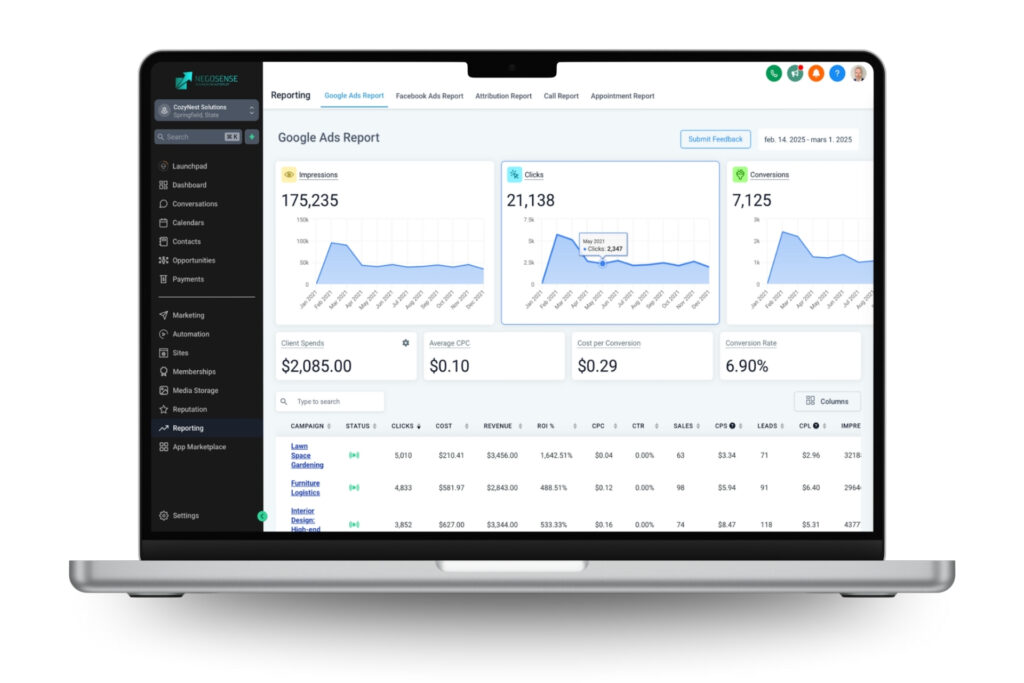
If you’re running plumber ads but aren’t tracking the calls they generate, you’re flying blind. You might be getting leads — but you won’t know which campaigns, keywords, or channels are pulling their weight (and which ones are just draining your budget).
Let’s fix that.
1. Use unique call tracking numbers
Use a different phone number for each campaign or traffic source. That way, you’ll know whether that call came from:
- A Google Ad vs a Facebook Ad
- A directory listing vs your SEO efforts
- A seasonal promo vs a regular service ad
Platforms like CallRail, Twilio, or our CRM make it easy to assign and track these numbers.
The Negosense CRM stands out among the best CRMs for home services with its extensive marketing and field service automations.
Real-World Example:
If you spend $500 on Google Ads and it generates 12 tracked phone calls, you know you’re paying ~$42 per lead. That’s data you can act on.
2. Record and review call quality
Call tracking tools often let you record calls. Reviewing a few each week can reveal:
- Missed opportunities (e.g., calls not answered)
- Gaps in your phone script or team training
- Whether callers were qualified leads or just shopping around
If your ads are working but your team isn’t closing — you don’t need better ads, you need better handling.
3. Tie leads to revenue
Tracking the number of calls is great. But to measure true Return on Ad Spend (ROAS), you need to ask:
- Did that call turn into a job?
- How much was the job worth?
- How much did we spend to get it?
Let’s say:
- You spend $1,000 on a campaign
- You get 25 calls
- 10 of those become booked jobs
- Each job brings in an average of $350
That’s $3,500 in revenue from $1,000 in spend — a 3.5x return. Now you’re not guessing. You’re scaling.
4. Automate follow-ups with missed calls
One of the easiest wins: set up a missed call text back automation. If someone calls but you miss it, send a message like:
“Hey! Sorry we missed your call. This is Joe from Top Notch Plumbing. How can we help?”
This alone can recover 10–30% of leads that would otherwise vanish.
Bottom line: Without tracking, you’re just throwing money at ads and hoping for the best. With tracking, you get a performance engine you can fine-tune and grow.
Want to streamline follow-ups and improve how you track leads? Our guide to plumbing business software breaks down the best tools to connect your ads to booked jobs.
How Much Do Plumber Ads Cost? Budgeting Tips for Maximum ROI
One of the first questions plumbing business owners ask is:
“How much should I spend on advertising?”
The short answer: It depends. But there is a smart way to budget, even if you’re just starting out. This section breaks down the typical cost of plumber ads across platforms and how to set a budget that grows with your business — without burning through your cash.
1. Understand the cost by ad type
Here’s what you can expect to spend on each major platform:
| Ad Platform | Typical Cost | What You’re Paying For |
| Google Ads (PPC) | $5–$20 per click (avg: $8–12 for plumbing) | Each click on your ad (high intent) |
| Facebook Ads | $5–$15 per 1,000 views (CPM) | Impressions (better for brand awareness) |
| Directory Listings | $20–$50/month or pay-per-lead | Leads or placement on platforms like Yelp |
| Offline Ads | Highly variable ($100–$2,000+/month) | Air time, print space, or mailer distribution |
Pro tip: For Google Ads, expect to pay around $30–$80 per lead, depending on competition, targeting, and ad quality.
2. Start with a manageable monthly budget
If you’re running ads for the first time, a good starting budget is $500–$1,000/month. This gives you enough data to:
- Test different keywords or audiences
- See what’s converting
- Adjust before scaling
Avoid spreading your budget too thin across too many platforms. It’s better to master one channel (like Google Ads) before adding others.
3. Set cost-per-lead and ROI goals
Instead of guessing, work backward:
- How much is your average job worth? ($250? $500? More?)
- What’s the max you’re willing to pay to get that job? (Ideally 10–30% of revenue)
- What conversion rate can you realistically expect?
Example:
- If you get 20 clicks at $10 each = $200
- 1 in 5 calls = $200 per lead
- If that job is worth $600, you’re still at a 3x return
4. Know when to scale your spend
Once your campaigns are profitable — meaning you’re generating leads at a cost you’re happy with — scale slowly. Don’t double your budget overnight. Increase by 10–20% per week and monitor performance.
Scaling too fast can tank your ROI if your team or follow-up systems aren’t ready for more volume.
Final tip: Budget for landing pages, not just clicks
Don’t forget to account for:
- Call tracking software
- Landing page design tools or hosting
- CRM or automation tools to follow up with leads
An extra $100–$200/month in tools can easily double or triple your ad results if used right.
Common Plumber Advertising Mistakes to Avoid
Even well-meaning campaigns can flop if you’re not careful. Here are the most common — and expensive — mistakes plumbing businesses make when running ads:
- Targeting the wrong keywords
Broad or irrelevant terms lead to unqualified clicks and wasted spend. - No negative keywords
Without them, you’ll pay for clicks like “free plumbing tutorial” or “DIY pipe repair.” - Sending traffic to a homepage
Generic pages confuse users and kill conversions. Every ad needs a focused landing page. - No call tracking
If you can’t trace which ads are generating leads, you can’t improve or scale effectively. - Failing to follow up
Missed calls, delayed responses, or no automation = lost revenue. - Spreading the budget too thin
Testing every platform at once usually means none of them work well.
Want to go deeper into building a system that consistently brings in new customers? Check out our plumber lead generation strategies for more expert tips.
Final Thoughts on Running High-Performing Plumber Ads
Plumber ads — when executed properly — are one of the fastest ways to grow your plumbing business. Whether you’re focused on emergency calls, seasonal promos, or building long-term visibility, paid ads give you direct access to homeowners searching right now.
But clicks alone don’t pay the bills. Success comes from matching the right message to the right audience, tracking every lead, and turning those calls into booked jobs.
If you’re ready to stop guessing and start growing, we can help. We don’t just run ads — we build lead generation systems that connect your business to real customers and prove their value every month.
Book a Free Strategy Call and see how we can build a campaign that brings leads in while you’re out on the job.
FAQ: Plumber Ads & Paid Advertising for Plumbing Businesses
Are plumber ads worth it?
Yes — if done correctly. Plumber ads target people who are actively searching for services like “emergency plumber near me” or “drain cleaning in [city].” These are high-intent leads that are much more likely to convert than general traffic. With proper tracking and targeting, plumber advertising consistently delivers a strong return on investment.
What’s the best advertising platform for plumbers?
Google Ads is usually the best place to start for plumbers because it captures people at the moment they’re searching for help. Facebook and Instagram Ads are great for brand awareness and seasonal promotions. Local directories like Yelp or Angi can also work if you have strong reviews.
How much should a plumbing business spend on advertising?
Most local plumbing businesses start with $500–$1,000/month, depending on their market and goals. As your campaigns prove profitable, you can gradually scale up. The key is to measure cost-per-lead and return on ad spend (ROAS) so you’re not just spending — you’re investing.
How do I know if my plumber ads are working?
Use call tracking, conversion tracking, and landing page analytics. Don’t just track clicks — track phone calls, form submissions, and actual jobs booked. If your cost per lead is lower than the average revenue per job, your campaign is working.
Can I run plumber ads myself, or should I hire someone?
You can run basic campaigns yourself, especially with tools like Google’s Smart Campaigns. But if you’re serious about scaling, hiring an expert or agency (with experience in local service ads) can save you money in the long run by avoiding costly mistakes and improving performance.
Articles Related to Plumber Ads
- The Ultimate Guide to Plumbing Management Software
- The Ultimate Guide to Creating a Free Plumbing Website
- Plumbing Lead Generation Services: Boost Your Business with These Expert Tips
- How to Grow a Plumbing Business
- Plumbing SEO: How to Get More Leads Without Wasting Money on Ads
- Plumbing Marketing Strategies to Grow Your Business
- Plumber Ads: Run Profitable Campaigns in 2025