Marketing Strategy
How to Grow Your HVAC Business in 2025
Most HVAC business owners hit a wall. Not because they’re bad at their trade, but because they never learned how to build a business.
Maybe you’re great at fixing systems, managing installs, or even training new techs… but when it comes to getting consistent leads, hiring the right people, pricing for profit, or scaling without losing your mind, it’s a different game entirely.
And let’s be honest: most advice out there is either:
- Written by software companies pushing demos,
- Or written by people who’ve never run a crew in their life.
This guide is different.
Whether you’re stuck around $300K or trying to break $1M+, this is the step-by-step playbook for growing a modern HVAC business; built around systems, strategy, and sustainable revenue. No fluff. No vague tips. Just what works.
You’ll learn how to:
- Price for profit (without losing bids)
- Hire a team that doesn’t ghost you
- Set up automations that follow up so you don’t have to
- Build repeatable revenue through service agreements
- Get leads, convert them, and stay top of mind with the 4C Growth Engine
If you’re ready to stop running your business on gut instinct and start growing it with clarity. This is your roadmap.
Table of Contents
- 2. Set the Foundation: Mindset, Metrics & Vision
- 3. Offer Strategy: Services, Pricing & Profit That Doesn’t Leak
- 4. Build the Machine: Operations, Systems & Automation
- 5. The 4C Growth Engine: Build a Customer Acquisition System That Compounds
- 6. People: Hiring, Training & Team Culture
- 7. Repeatable Revenue: Service Agreements & Off-Season Strategy
- 8. Growth Playbooks: Expansion, Acquisition & Exit Strategy
- 9. Real-World Scenario: Scaling an HVAC Business from $300K to $1.2M
- 10. Final Thoughts: The Difference Between Stuck and Scaling
- FAQs: Growing Your HVAC Business
- Articles Related to Growing an HVAC Business
2. Set the Foundation: Mindset, Metrics & Vision
Before you tweak ads, change pricing, or hire your next tech, lock this in:
You’re not just a technician anymore — you’re the owner. The boss. The one driving the whole machine.
If you want to grow your HVAC business, you’ve got to think like a business owner.
That means using data over guesswork. Planning like a CEO, not hustling like a contractor.
Here’s how you build that foundation.
Mindset: From Tradesperson to Business Builder
Most HVAC businesses are run by skilled techs who never learned to be CEOs.
They’re good at the work but bad at the business. That gap is where growth dies.
If that’s you, here’s the hard truth:
You’ll never grow past your own capacity until you replace hustle with systems.
You’re not paid for hours anymore. You’re paid for decisions.
- Are you spending your day on $20/hour work or $500/hour work?
- Are you firefighting or building something scalable?
- Are you acting like a boss, or just playing one?
Real growth starts when you stop seeing yourself as “in the trades” and start running a company that delivers HVAC services.
Metrics That Matter (And What to Track Weekly)
If you can’t measure it, you can’t grow it.
These are the non-negotiable numbers you need to know, weekly:
| Metric | What It Tells You |
| Revenue | Are you growing at all? |
| Gross Profit (%) | Are your jobs priced right? |
| Net Profit (%) | Are you actually keeping money? |
| Close Rate | Are your leads converting? |
| Average Ticket | Are you upselling, bundling, and maximizing each call? |
| Booked Jobs / Leads | Is your marketing working, or leaking cash? |
| Labor % of Revenue | Is your tech team efficient? |
Track these. Review them. Make decisions off them.
Don’t wait until tax season to find out you’re bleeding profit.
Vision: Decide Where You’re Going
Most HVAC owners say they want to “grow”. But what does that even mean?
Here’s how to get real:
- Revenue goal (next 12 months)
- Net profit goal (minimum 10% target)
- How many jobs per month?
- How many techs? How many trucks?
- What services stay? What services go?
Then ask yourself:
“If my business keeps running exactly like it is today, will I hit those numbers?”
If not, something has to change. This guide will show you where to start.
But make no mistake:
If you don’t define your numbers, you’ll chase growth forever and never know if you’re winning.
You’ve set your sights. Now it’s time to tighten up your offer and pricing — so you’re not just working harder, but keeping more.
3. Offer Strategy: Services, Pricing & Profit That Doesn’t Leak
Let’s clear something up: most HVAC businesses don’t need more services, they need better strategy around what they offer, who they offer it to, and how they price it.
You’re not Home Depot. You don’t have to serve everyone.
And growth doesn’t come from adding more. It comes from selling the right services at the right margins to the right customers.
Here’s how to dial it in.
Narrow the Offer. Widen the Profit.
The fastest way to simplify your operations and boost profit?
Stop trying to be everything to everyone.
Ask yourself:
- Are we focused on residential or commercial?
- Do we want to lead with installs, maintenance, or service calls?
- Are we taking one-off repair jobs that kill our schedule?
- What services are high-effort but low-profit?
You don’t have to drop services overnight. But you do need to focus.
The businesses that grow are the ones that specialize, streamline, and scale intentionally.
Stop Pricing Like You’re Desperate
Most HVAC companies undercharge. Not because of the market, but because of fear.
If your jobs are barely profitable… If your net profit is under 10%… If you’re still quoting by instinct instead of data…
You’re building a house on sand.
Here’s what solid pricing looks like:
- Gross Profit Target: 40% minimum
- Net Profit Target: 10–20%
- Overhead Cap: No more than 35% of revenue
- Labor & Materials Costs: Tracked religiously
Use a price book. Use tiered options. Use packages.
Make the customer feel in control. But structure the sale so every outcome is profitable.
Bundle, Don’t Nickel-and-Dime
Want to raise your average ticket without losing the sale?
Stop selling just the fix. Sell the future.
Examples:
- System replacement → include smart thermostat + IAQ + first-year maintenance
- Service call → offer upgrade credit toward install
- AC tune-up → bundle with drain line flush, filter swap, and seasonal inspection
Bundling increases perceived value and margin, while reducing customer friction.
Pro Tip: Keep, Fix, Cut
Quick 3-column exercise:
| Keep (High margin, scalable) | Fix (Low margin, high effort) | Cut (Not worth it) |
| System installs | Emergency repairs | Custom duct fabrication |
| Maintenance plans | After-hours calls | One-off inspections |
| Add-ons like IAQ | Refrigerant top-offs | Warranty support on 3rd-party jobs |
This changes the game. Instead of being reactive, you become deliberate about what grows your bottom line.
Now that your services and pricing are locked, it’s time to fix the backend, because no offer scales without strong systems.
4. Build the Machine: Operations, Systems & Automation
You can have the best pricing, the best offer, and a full pipeline of jobs.
But if your backend is a mess, growth will bury you.
Most HVAC businesses don’t hit a wall because of marketing.
They hit it because the business can’t handle more volume without breaking.
Here’s how to fix that.
Systems Make You Scalable
Think of your business like a machine.
The more moving parts you have: techs, trucks, invoices, customers, the more things can go wrong.
That’s why top-performing HVAC companies don’t rely on memory, guesswork, or sticky notes.
They use:
- Standard operating procedures (SOPs) for every task
- Templates for quotes, invoices, and job notes
- Defined roles with clear accountability
- Simple dashboards to track jobs, revenue, and performance in real time
Don’t wait until you’re overwhelmed to get organized.
Document the way you want things done now, so others can do them without you.
Tech Stack That Runs 24/7 (Even When You Don’t)
If you’re still quoting jobs in Word docs and chasing people with voicemails, you’re leaking time and money.
Here’s the baseline of a modern, efficient HVAC business:
- CRM: Central brain of your ops (customer data, job history, pipeline)
- Scheduling/Dispatching Tool: No more double-bookings or lost appointments
- Automated Follow-Up: Missed call text-back, quote follow-up, no-show re-engagement
- Mobile Access for Techs: So they can clock in, upload photos, and complete checklists from the field
- Digital Invoicing & Payments: Speed up cash flow and reduce admin
None of this needs to be complicated.
But it does need to be centralized, automated, and accessible.
If you don’t have a central CRM managing customer data, job tracking, and follow-ups, you’re leaking time and money. Our HVAC CRM system can help you streamline operations and automate your pipeline.
Automate the Stuff That Steals Your Time
If a task happens more than twice, you should systemize it.
Here’s what to automate first:
- Missed Calls → Instant SMS + follow-up workflow
- Estimates → Quote sent → 24-hour reminder → 3-day close-or-loop
- Job Confirmations → Reminder text the day before + ETA text on the day
- Review Requests → Triggered after job completion
- Maintenance Reminders → Recurring schedule 6 months after last visit
This stuff isn’t “nice to have.”
It’s how your business becomes consistent. Even when you’re not hovering over it.
Build for Data, Not Just Gut Instinct
Once your ops are structured, you unlock what most HVAC owners never get: visibility.
Now you can answer:
- Which techs close best?
- What services are actually profitable?
- How many jobs are coming from follow-up vs new leads?
- Where are we losing time, money, or customers?
Without this visibility, you’re just guessing.
With it, you can make smart hires, tighten margins, and scale without chaos.
Now you’ve got the machine running. Let’s fuel it.
It’s time to turn on the 4C Growth Engine, and build predictable customer acquisition that compounds over time.
5. The 4C Growth Engine: Build a Customer Acquisition System That Compounds

By now, you’ve locked in your offer, your margins, and your internal systems.
But none of that matters if your phone doesn’t ring.
The 4C Growth Engine is how you create predictable, high-quality customer flow, and turn your HVAC business into a lead-generating, revenue-producing machine.
This isn’t just marketing.
It’s a framework for attracting the right jobs, building trust, converting efficiently, and staying visible, month after month.
1. Clickability → Get Found. Get Clicked.
If you’re not showing up in local searches or ads, you’re invisible.
Clickability is about being where your ideal customers are looking, and giving them a reason to choose you.
Focus on:
- Google Business Profile: Optimize for local pack visibility with keywords, categories, and photos
- SEO: Rank for service + city keywords (“AC repair in [city]”) with targeted pages
- Google Local Service Ads: Show up at the top — and pay per booked lead, not just per click
- Meta Titles + Descriptions: Write headlines people want to click, not just what describes the page
- Social proof in ads: Plug in real review snippets in your creative
This isn’t about going viral, it’s about showing up when people are ready to buy.
Want to get found faster and book more installs? Our HVAC PPC services can help you dominate Google with Local Service Ads and high-converting campaigns.
2. Credibility → Turn Traffic Into Trust
People don’t buy HVAC services from strangers.
They buy from pros they believe can get the job done right, without the runaround.
Credibility makes you that pro before the phone call.
Make sure your brand signals trust:
- Mobile-optimized website that loads fast and looks professional
- Reviews & testimonials front and center — with real names, real locations
- Before/after photos of your work
- Certifications and guarantees clearly displayed
- Content that answers key buyer questions: “Do I need a new system or just a repair?”
If your online presence doesn’t build confidence in 5 seconds or less, you’re leaving money on the table.
3. Convertibility → Book Jobs, Not Just Clicks
Getting leads isn’t growth. Booking jobs is.
Convertibility is about reducing friction, responding fast, and making it easy for someone to say yes.
Nail the basics:
- Clear service pages with trust-building copy and fast-loading CTAs
- Quote request forms that actually work on mobile
- Click-to-call buttons everywhere (and track them)
- Missed call text-back so no lead dies after hours
- Automated follow-ups: Quotes, estimates, “still need help?” nudges
People are impatient. The first company that responds like a pro usually wins.
Be that company.
4. Consistency → Stay Top of Mind, All Year Long
Most HVAC customers won’t convert the first time they hear about you.
But they will come back, if you stay in their orbit.
Consistency is what builds long-term growth through brand recall, referrals, and repeat business.
Keep the drumbeat going:
- Email and SMS campaigns to follow up on unsold estimates, offer seasonal promos, and nurture past customers
- Automated review requests after every job
- Retargeting ads for website visitors who didn’t convert
- Social media presence that doesn’t go dark in the off-season
- Blog and content updates that boost SEO and help build authority
Think of it like this:
You’re not just marketing for today — you’re marketing for every future emergency, install, and neighbor referral.
When these four C’s work together, you get more than leads, you get leverage.
- Leads cost less (because SEO compounds)
- More leads convert (because you’ve built trust)
- Fewer slip through the cracks (because your system handles follow-up)
- More repeat work (because you stay visible without chasing)
That’s not a campaign. That’s a growth engine.
Consistent visibility isn’t luck — it’s strategy. Our HVAC digital marketing services are designed to keep your brand top of mind year-round through SEO, retargeting, and automated campaigns.
Next up: You’ve got customers coming in. Now you need the right people to deliver. Let’s talk hiring, training, and building a team that helps you grow without burning out.
6. People: Hiring, Training & Team Culture

You can’t scale without people who can deliver.
You can have great pricing, efficient systems, and leads on autopilot. But if your team can’t execute consistently, growth turns into chaos.
Hiring in this industry is hard. Training is inconsistent. Culture is usually an afterthought.
Fixing that gives you a real edge, because most HVAC companies never do.
Here’s how to build a team that doesn’t just show up, they help you grow.
Why HVAC Hiring Is Broken (And How to Fix It)
The trades are in a hiring crisis. But it’s not just about labor shortages.
The bigger problem is how most companies hire:
- No clear role definition
- No onboarding process
- No training plan
- No incentive to stick around
So what happens? You either hire fast and regret it, or avoid hiring at all and become the bottleneck.
The fix starts with treating hiring like sales:
- Attract the right people with a clear offer (why work for you?)
- Qualify them with values-based interviews
- Close them with structure, support, and real growth potential
Build Your Org Chart Before You Need It
Most HVAC owners hire reactively. Someone quits or gets overloaded, so they scramble to find help.
A better way? Define your future org chart now. Even if you’re wearing all the hats today.
Example org chart:
- Owner / GM
- Dispatcher / Admin
- Service Techs
- Install Crew
- Comfort Advisor / Sales Tech
- Marketing Assistant or VA
You don’t have to fill every role at once.
But when you see your business like a machine, you stop plugging holes and start building parts.
Hire for Values, Train for Skill
You can teach someone how to run a service call.
You can’t teach work ethic, communication, or how someone handles pressure.
Focus on hiring people who:
- Show up early
- Take ownership
- Communicate clearly
- Want to grow
Hire slow. Fire fast. And make it clear what winning looks like from Day 1.
Once they’re in the door, training is how you protect your reputation and scale without sacrificing quality.
Sales Techs vs Installers vs Service Pros: Train Them Differently
Too many HVAC businesses expect every tech to do everything.
That’s not how high-performing teams operate.
Train your team based on role and outcome:
- Installers: Focus on speed, accuracy, and customer handoffs
- Service Techs: Train for diagnosis, upsells, and maintenance plan pitches
- Sales Techs / Comfort Advisors: Focus 80% of training on communication, needs discovery, and high-ticket closing
Don’t assume because someone’s great in the field, they’ll be great in front of a customer.
And don’t assume your top seller is following the right process.
Training isn’t just technical. It’s strategic.
Use Incentives That Actually Work
What gets rewarded gets repeated. If you want more revenue, better service, and fewer headaches. Incentivize what matters.
Effective HVAC team incentives:
- Performance pay tied to revenue or close rate
- Spiffs for 5-star reviews or selling maintenance agreements
- Bonuses for training completion or certifications
- Team-wide contests for installs, upgrades, or no-callback streaks
And remember: incentives aren’t just financial.
Public praise, growth opportunities, and flexibility go a long way too.
If you want loyalty, build a company people are proud to work for. Not just paid by.
Let’s talk about consistency next. Because the real power move isn’t just chasing more jobs. It’s locking in recurring revenue and off-season work that keeps your cash flow steady year-round.
7. Repeatable Revenue: Service Agreements & Off-Season Strategy
Most HVAC businesses ride the revenue rollercoaster: busy in summer, stressed in winter, unpredictable in between.
It’s not sustainable.
If you want to grow with less chaos, you need stable, repeatable income that doesn’t depend on weather, luck, or last-minute calls.
That’s where service agreements and a proactive off-season strategy come in.
Why Service Agreements Are a No-Brainer
Service agreements aren’t just about tune-ups.
They’re about predictable revenue, smoother scheduling, and loyal customers.
Here’s what they unlock:
- Recurring income (even in slow months)
- Increased customer lifetime value
- Built-in upsell opportunities
- More reviews, referrals, and trust
- Higher booking rates from warm leads
They also keep your techs busy and paid, which helps with retention.
The businesses with the steadiest cash flow usually have the strongest service plan game.
How to Build (and Sell) a Service Agreement That Actually Converts
The offer doesn’t have to be fancy. It just has to be clear and valuable.
Core elements of a great plan:
- 2 maintenance visits per year
- Priority service (front-of-line during peak season)
- Discounted repairs or diagnostics
- Filter changes or IAQ add-ons
- Clear pricing: monthly or annual payment options
Train techs to offer the plan at the end of every install or service. Not as a pushy pitch, but as a way to protect the customer’s investment and avoid future problems.
Make it easy to enroll. Bonus if they can sign up and pay on the spot, digitally.
Winning the Off-Season: Don’t Wait Around for Calls
The slow season doesn’t have to mean panic.
Here’s how to generate work when demand drops:
Reactivate Past Customers
- Send SMS and emails to anyone you haven’t serviced in 6–12 months
- Offer a discounted system check-up or free inspection
- Use scarcity: “Limited tech slots available next week only”
Pre-Schedule Seasonal Tune-Ups
- Book spring and fall maintenance in advance (ideally at the time of sign-up)
- Use automated reminders to confirm and reschedule
Package Off-Season Specials
- “Winter Efficiency Bundle” — tune-up + IAQ + smart thermostat
- “Pre-Summer Prep” — AC inspection + drain line flush + filter swap
Train, Optimize, and Systemize
- Use the slower months for team training, SOP updates, CRM cleanup, and process optimization
- Get your systems tight before the next wave hits
You can’t control the weather. But you can control your plan.
Stacking Recurring Revenue Over Time
If you sell just 8 service agreements per month:
- That’s 96 agreements in a year
- At $15/month = $17,280 in annual recurring revenue
- Plus dozens of automatic upsell opportunities
Do that for three years? You’re sitting on a goldmine of loyal customers, repeat work, and off-season insulation.
You’ve built the machine. Now, do you expand, acquire, or systemize for exit?
Let’s look at your growth playbooks and what to do after you hit your first major milestone.
8. Growth Playbooks: Expansion, Acquisition & Exit Strategy

You’ve got solid margins, systems in place, leads flowing, and a team that can execute.
Now what?
This is where most HVAC owners get stuck. They hit $1M or $2M, things feel “fine,” and they plateau. But if you want to grow beyond being a busy operator — into an owner with true freedom — you need to pick your next play on purpose.
There are only a few viable paths forward:
- Expand into new locations
- Add new verticals
- Acquire a competitor
- Systemize and step back
- Sell (or prep to sell later)
Let’s walk through each one.
Expand into New Service Areas
If your current market is tapped out or highly competitive, consider growing horizontally.
How to know it’s time to expand geographically:
- Your local lead costs are climbing
- Your trucks are already hitting capacity
- You’re turning away jobs outside your zip code
Expansion doesn’t mean opening a new office on day one.
Start with:
- Micro-targeted PPC/LSA campaigns in neighboring suburbs
- A landing page for “[City Name] HVAC Services”
- A test run with one or two install jobs in the new area
- A dedicated tech who lives nearby, if possible
Validate demand before you invest heavily.
Add-on Services: Cross-Sell Without Diluting Focus
A well-run HVAC business already has the infrastructure to bolt on new verticals, if they make sense.
Popular plays:
- Indoor air quality (IAQ): High-margin, low-effort upsells
- Plumbing or electrical: Great if you already have a loyal customer base
- Home energy audits: Pairs well with HVAC replacement + rebates
- Duct cleaning: Recurring, easy to train, complements maintenance plans
Don’t chase shiny objects.
Only expand services if they share your customers, your techs, or your tools.
Acquisition: Buy Growth Instead of Building It
Want to grow faster without starting from scratch?
Consider acquiring a smaller company in your area, especially one with:
- A good reputation but weak systems
- An aging owner looking to exit
- Solid recurring customers but no digital marketing
- Techs you’d actually want on your team
Acquisitions give you immediate access to talent, customers, trucks, and local SEO authority, if done right.
Pro tip: If they have 100 service agreements and you pay $150K, you might recoup your investment in under 12 months.
Systemize to Scale (Even If You’re Not Expanding)
You don’t have to keep growing. You just have to stop doing everything yourself.
Want freedom?
Start replacing yourself in phases:
- Dispatch → trained CSR or office manager
- Sales → Comfort advisor or lead tech
- Tech oversight → Install manager or field supervisor
- Day-to-day decisions → General manager or ops lead
If you’re doing $1M+ and still running every quote, scheduling every job, and putting out fires 24/7 — it’s time to shift.
The goal isn’t always more revenue.
Sometimes it’s more margin, less stress, and a business that runs without you.
Exit Strategy: Build a Business Someone Would Want to Buy
Even if you never plan to sell, you should build like you will.
Buyers don’t want your truck. They want:
- Recurring revenue
- Documented processes
- Clean financials
- An org chart that doesn’t revolve around you
- A brand with customer equity
Build your business like an asset, not just a job with overhead.
This gives you options:
- Sell it
- Pass it down
- Or keep it and pull yourself out of day-to-day while the company keeps growing
You’ve got the whole blueprint. Now let’s bring it to life, with a practical scenario showing how these steps work together to scale a business from $300K to $1M+.
9. Real-World Scenario: Scaling an HVAC Business from $300K to $1.2M
Theory is nice. Execution is what counts.
So let’s walk through a realistic growth path — applying the exact strategies in this guide — and see how an HVAC business can scale from barely scraping by to passing the million-dollar mark with systems, confidence, and profit.
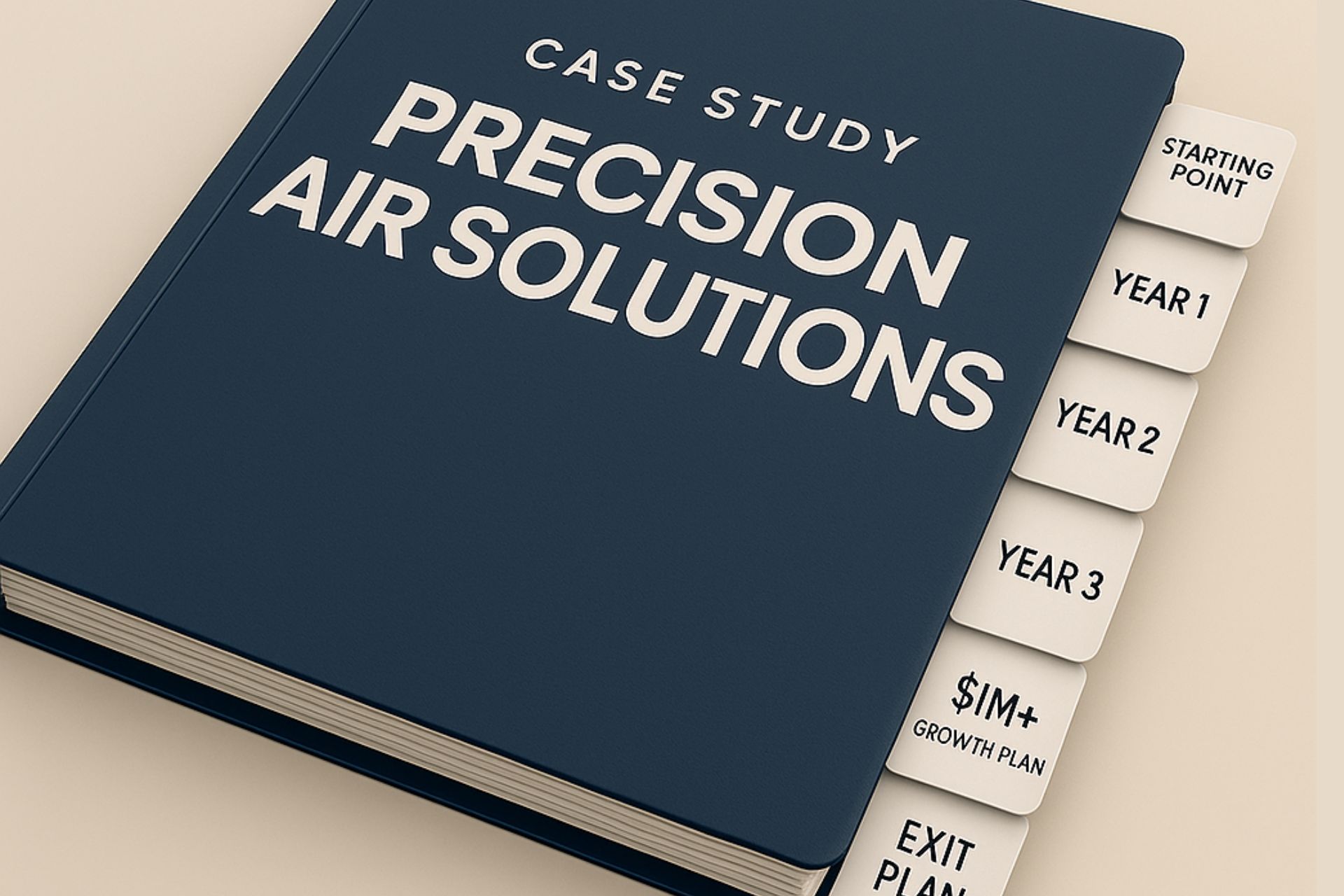
Meet our fictional company: Precision Air Solutions, a small residential HVAC business in a mid-sized market, currently doing around $300K/year in revenue.
Here’s how they scale over the next three years.
Year 1: Stabilize & Systemize
Starting Point:
- One owner/operator doing everything
- Occasional helper during busy season
- No website, no CRM, pricing inconsistent
- Word of mouth is the only lead source
What they do:
- Implement a CRM to track leads, jobs, and follow-ups
- Raise prices to target a 40% gross profit
- Launch a basic, high-converting website with service pages and a quote form
- Turn missed calls into texts and automate quote follow-ups
- Create SOPs for service, invoicing, and scheduling
Results:
- Bookings become more consistent
- Owner spends less time chasing paperwork
- Revenue grows to $450K with better job profitability
- Owner hires a full-time tech and part-time CSR
Year 2: Build the Engine & Drive Demand
Now at:
- Owner + 1 full-time tech + part-time office help
- Solid systems, but still relying on referrals
What they do:
- Turn on the 4C Growth Engine:
- Local SEO
- Google Local Service Ads
- Review-building campaigns
- Retargeting ads
- Email reactivation for past customers
- Launch a service agreement program
- Create a basic offer stack: tune-ups, replacements, IAQ upsells
- Build and promote maintenance bundles in the slow season
- Train the tech in light sales and customer education
Results:
- Service agreements hit 50+
- Average ticket increases with bundled offers
- Revenue jumps to $725K
- Tech’s commission makes him loyal, not looking
Year 3: Scale Intentionally
Now at:
- Owner mostly out of the field
- Systems + lead flow + trained techs = momentum
What they do:
- Hire a second service tech and a comfort advisor
- Owner fully steps back from installs and repairs
- Build out org chart with defined roles
- Expand PPC to nearby suburb
- Sell 8–10 service agreements per month
- Test duct cleaning as a new add-on vertical
Results:
- Steady lead flow from SEO, reviews, and email
- Maintenance plan revenue hits $1,200/month recurring
- Revenue passes $1.2M, with strong profit and minimal chaos
- Owner takes a vacation for the first time in years — and the business keeps running
The Takeaway
Scaling isn’t about hiring a dozen people or dumping money into ads.
It’s about building the right foundation, dialing in your offer, and turning your business into a machine that can grow without grinding you down.
This is exactly what most HVAC business owners never do — because they’re too busy reacting.
But if you follow the playbook step by step, like Precision Air Solutions did, growth becomes predictable — not stressful.
10. Final Thoughts: The Difference Between Stuck and Scaling

Most HVAC business owners don’t fail because they aren’t skilled.
They fail because they never switch from doing the work to building the business.
They stay stuck chasing calls, managing chaos, and wondering why growth always feels just out of reach.
The companies that break through?
They follow a system.
They make decisions based on numbers, not emotions.
They build teams, create leverage, and install processes that work whether they’re in the field or not.
Growth isn’t a mystery. It’s a series of decisions made with discipline.
This guide gave you the blueprint:
- Dial in your offer and pricing
- Systemize your operations
- Use the 4C Growth Engine to drive demand
- Hire and train like a real company, not a solo hustle
- Lock in service agreements and recurring revenue
- Scale intentionally — or step back on your own terms
You don’t have to implement everything at once.
But you do need to start.
Your Next Step
If you want help implementing this in your own business —
from building your site and CRM, to automating follow-ups, to filling your pipeline with leads — we do this every day for HVAC companies like yours.
Book a free strategy call. We’ll look at your current setup and show you what to fix first to unlock real growth.
Schedule Your Free Call Here.
Or if you’re still early, check out the rest of our blog. This post is just the beginning — there’s a full library of tactical guides waiting for you.
Whatever you choose: don’t sit still.
Every week you wait is another job lost to a competitor who did build the engine.
Let’s get to work.
FAQs: Growing Your HVAC Business
1. What’s the fastest way to grow an HVAC business?
Focus on high-ticket installs, raise prices to protect margin, implement automations for lead follow-up, and run Local Service Ads to drive immediate booked jobs.
2. How much profit should an HVAC company make?
Target 40%+ gross profit and 10–20% net profit. If you’re below that, revisit pricing, service mix, labor efficiency, and overhead.
3. How do I get more HVAC leads?
Optimize your Google Business Profile, run Local Service Ads, collect reviews consistently, and use retargeting and email/SMS follow-ups to convert cold leads.
4. Should I offer HVAC maintenance plans?
Yes — they create recurring revenue, increase lifetime value, improve scheduling consistency, and lead to more upsells and referrals.
5. When should I hire my first tech or CSR?
As soon as revenue allows and systems are in place. Don’t wait until you’re overwhelmed — proactive hiring prevents burnout and bottlenecks.
Articles Related to Growing an HVAC Business
- How to Get HVAC Leads That Actually Convert
- Ultimate Guide to HVAC Marketing
- HVAC Marketing 101: Strategies for Growth
- 2025 HVAC Ads Guide: Google, Facebook, PPC
- How to Build an HVAC Website That Converts
- HVAC Marketing Plan: How to Get More Customers
- The Best Free HVAC Scheduling Software in 2025
- The Ultimate Guide to SEO for HVAC Companies