AI & Automation
AI for Home Services: A Practical Guide to Tools, Use Cases & Adoption Levels
The AI Advantage for Home Service Pros
If you think AI is just for tech giants or Silicon Valley startups, think again. Home service businesses — from HVAC and plumbing to landscaping and electrical — are using AI right now to get more leads, follow up faster, and automate the boring stuff that eats up your day.
This isn’t about robots taking over. It’s about helping small teams work like big ones — without hiring more staff. In this guide, we’ll break down exactly how AI is being used by service businesses, show you practical tools that are working today, and walk you through the 6 levels of AI adoption so you can see where you are — and what’s next.
Why AI Matters for Home Service Businesses
Let’s be honest — running a service business is chaos.
Missed calls. No-shows. Late payments. Endless admin work. You’re constantly juggling customer expectations with a to-do list that never ends. That’s where AI comes in — not as a gimmick, but as a real solution to real problems.
Here’s why AI is no longer optional:
- Consumers expect speed. If you’re not replying fast enough, someone else will. AI helps you follow up instantly — even after hours.
- Your time is expensive. Repeating the same admin tasks every day burns hours. AI can automate lead follow-up, appointment reminders, reviews, and more.
- Competition is rising. The companies growing fastest aren’t just better at the job — they’re better at systems. AI is part of that system.
Whether you’re a one-person plumbing outfit or a 10-person HVAC team, AI helps you do more with less — and stay ahead of businesses that are still stuck in 2018.
Real AI Use Cases in Home Services
AI isn’t some abstract concept — it’s already being used by smart service pros to automate tasks, book more jobs, and deliver a smoother customer experience. Here’s how it shows up in the real world, across four key areas:
1. Lead Generation & Follow-Up
Most home service businesses lose leads not because they don’t get enough — but because they don’t follow up fast enough. AI solves that.
- Missed-Call Text Back: Automatically texts a lead if you miss their call, keeping the conversation alive.
- AI-Powered Chatbots: Answers questions on your site 24/7 and collects lead info even while you sleep.
- AI-Generated Emails & SMS: Drafts or even sends personalized follow-ups, estimates, and reminders with zero manual input.
Example: An HVAC business captures 30% more leads monthly by using an AI chatbot + missed call automation in GoHighLevel.
2. Scheduling & Operations
AI doesn’t just help with marketing — it streamlines how you run the business behind the scenes.
- Smart Scheduling Assistants: Book appointments based on availability, travel time, and job type — no double-booking or back-and-forth texting.
- Route Optimization: Use AI to plan daily routes that minimize travel and fuel costs.
- Work Order Automation: Automatically assign tasks, update job statuses, and sync field data to your CRM or calendar.
Example: A landscaping company cuts admin time in half by using AI to schedule crews, optimize routes, and send updates to clients automatically.
3. Customer Experience
In service industries, reputation is everything. AI helps you deliver faster, more consistent customer service — without hiring more people.
- AI Receptionists / Voice Assistants: Answer phones, book jobs, and escalate urgent calls.
- Review Requests: Automatically request reviews after a job is done, boosting your local SEO.
- Personalized Communications: Send messages tailored to client history, location, or past issues.
Example: A plumbing company uses AI to send customized maintenance reminders to past clients based on service history.
4. Internal Efficiency & Admin Automation
The real power of AI kicks in when it takes repetitive admin off your plate.
- Automated Invoicing & Payments: Send reminders, accept payments, and log them in your system without lifting a finger.
- AI Reporting Dashboards: Get insights on lead sources, close rates, or top-performing services with real-time data.
- Job Tagging & Categorization: Automatically tag jobs or client notes based on content or urgency.
Example: An electrical contractor uses n8n and OpenAI to sort inbound form submissions by urgency and job type before they hit the CRM.
Bottom line? AI doesn’t just help you market smarter. It makes your entire business run smoother — from the first click to the final invoice.
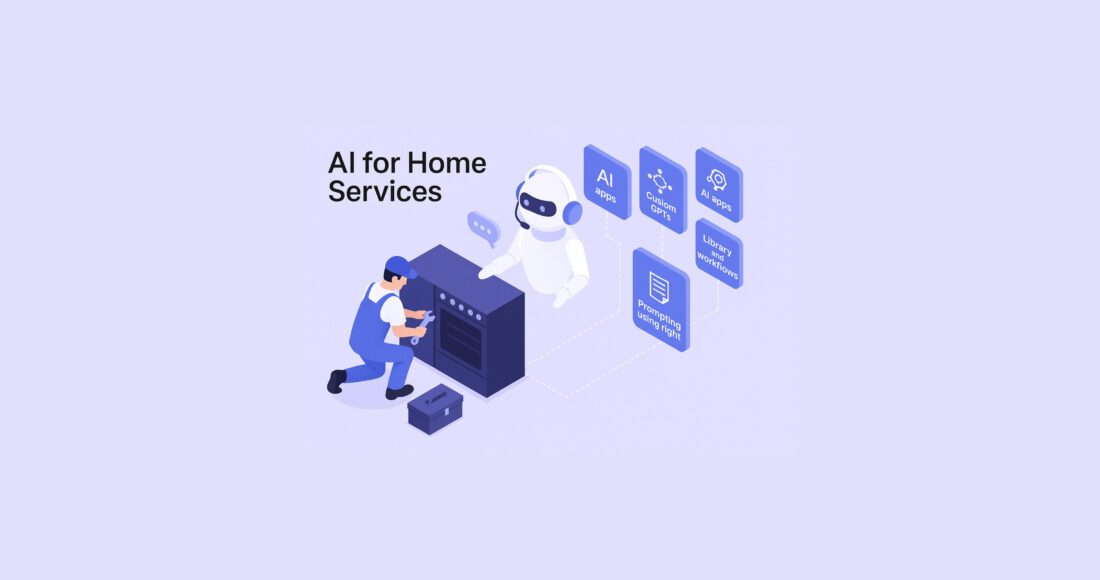
The 6 Levels of AI Adoption (And Where You Fit In)
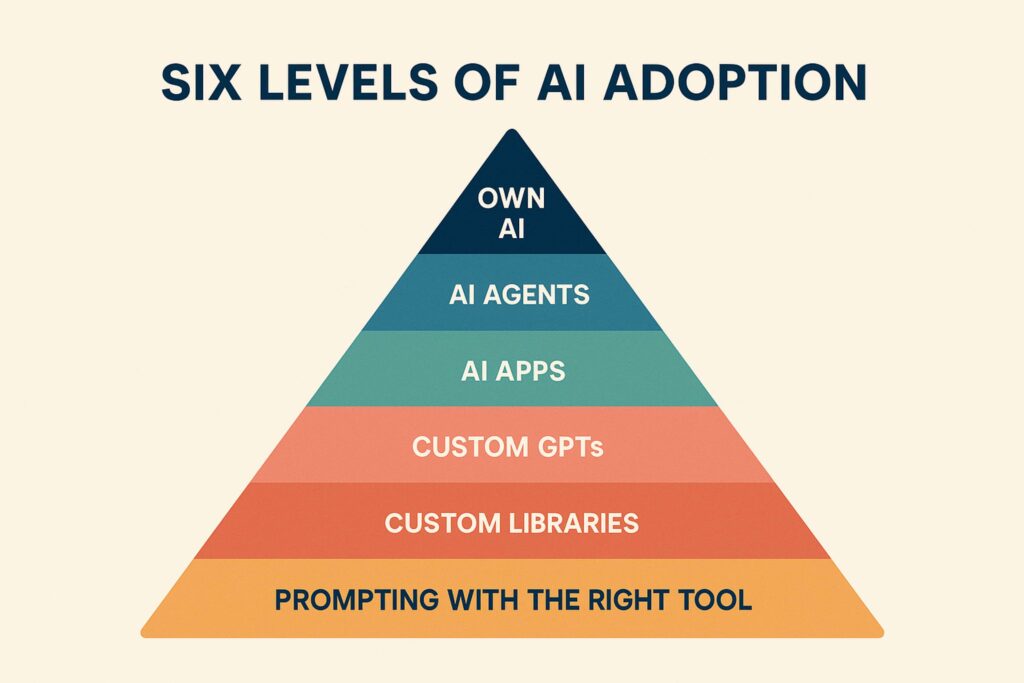
Not every business needs to build its own AI system — but every business can benefit from using AI smarter. That’s why we created a simple framework to help service pros understand where they are now, and what’s next.
Think of it as a ladder — and each level gets you closer to real automation, better margins, and a more scalable business.
Level 1: Prompting with the Right Tool
You’re using tools like ChatGPT, Claude, or Gemini to write emails, create ads, or help with planning. It’s manual, but helpful.
Example: You ask ChatGPT to write a sales page or generate follow-up email copy for leads.
Want to learn more? Check out our guide on how to use ChatGPT for your home service business.
Level 2: Libraries and Workflows
You’re starting to automate tasks using platforms like Zapier, Make, or n8n, often combined with AI. Now you’re saving real time.
Example: When a lead fills out a form, AI summarizes the request and auto-updates your CRM with the best-fit service tag.
Once you’ve got your prompts down, the next step is building consistency. Here’s how to create a prompt library your whole team can use.
Level 3: Custom GPTs
You’ve built task-specific GPTs to streamline parts of your business. These are easy to set up and incredibly effective.
Example: A custom GPT that writes SEO-friendly blog posts for your niche, or helps generate quote responses based on job details.
If you’re ready to build your own AI assistant, check out these 8 plug-and-play Custom GPT ideas you can launch today.
Level 4: AI Apps
You’re using off-the-shelf AI-powered apps to automate customer service, sales, and operations. These tools do one thing well — and fast.
Examples:
- GoHighLevel AI tools for reviews and follow-ups
- Jasper for content creation
- Surfer SEO for blog optimization
- Tidio for AI chat support
Prefer ready-made tools? Here’s a breakdown of the best AI apps for home service businesses — no setup required.
Level 5: AI Agents
This is where things get exciting. AI agents are semi-autonomous systems that can handle full workflows across multiple tools.
Example: An AI agent that responds to a lead, books the appointment, updates the calendar, emails a reminder, and logs everything in your CRM.
Curious what that looks like in the real world? Here’s how to get started with AI agents for your home service business.
Level 6: Own AI
This is the deep end. You’re building your own AI models trained on internal data — or even launching new products powered by AI.
Example: A smart HVAC company builds a predictive maintenance engine that recommends service intervals based on usage patterns and sensor data.
Ready to go full mad scientist? Here’s how home service businesses are starting to build their own AI tools from scratch — and when it actually makes sense to do it.
So Where Are You?
Most service businesses today are somewhere between Level 1 and 3 — and that’s okay. You don’t need to “go full AI” to see real results.
But the goal isn’t to play with AI — it’s to leverage it. And moving from Level 2 to 4 (automation + AI apps) is where the biggest wins happen.
The businesses that scale in 2025 won’t be the ones with the most trucks — they’ll be the ones with the smartest systems.
Where Should You Start?
Let’s be real — most home service businesses aren’t ready to build AI agents or train custom models. But you don’t need to be at Level 6 to get massive value from AI.
The key is to start where you are, and focus on solving one problem at a time.
Step 1: Identify Your Bottleneck
What’s costing you the most time, money, or missed opportunities right now?
- Too many missed calls?
- Leads going cold?
- Wasting hours on admin tasks?
- Inconsistent follow-ups or review requests?
Pick one of those problems — and you’ve got your starting point.
Step 2: Choose the Right Tool (Based on Your Level)
Here’s a quick cheat sheet:
| Problem | AI Level | Example Tool |
|---|---|---|
| Writing emails, ads, or blog posts | Level 1 | ChatGPT, Jasper |
| Missed calls + slow follow-up | Level 2 | GHL + Zapier workflows |
| Too much manual admin | Level 3–4 | Custom GPTs, AI-powered CRM |
| No 24/7 support or lead capture | Level 4 | Tidio, GoHighLevel chatbots |
| Need full workflow automation | Level 5 | AI agents with n8n, LangChain |
Step 3: Start Small, Automate One Thing
Don’t try to “AI your entire business” overnight. Automate one high-friction task — then move to the next.
Start with: Missed-call automation + AI follow-up → Then add smart scheduling → Then layer in email/voice AI.
Each layer frees up your time and increases your revenue potential.
Step 4: Get Expert Help (If You Want to Skip the Guesswork)
If you’d rather skip the testing, duct-taped tools, and wasted time, that’s what we do.
We build AI-powered systems for service pros — combining CRM, automation, and marketing to:
- Capture more leads
- Automate follow-up
- Book more jobs
- Streamline operations
You’ll get a done-for-you setup built around your workflow — no tech headaches, no fluff.
Book a Free Demo → See how we’d apply AI to your business in under 15 minutes.
Common Pitfalls to Avoid
AI is powerful — but it’s not magic. A lot of home service pros jump in with the wrong expectations or waste time on shiny tools that don’t move the needle.
Here are the biggest mistakes we see (and how to avoid them):
1. Thinking AI Will Replace Your Staff Overnight
AI doesn’t replace humans — it supports them. The best results come from using AI to handle repetitive, low-value tasks so your team can focus on what actually grows the business: great service, real conversations, and smart decisions.
Use AI to enhance your team, not eliminate it.
2. Choosing Tools That Don’t Integrate
You grab a cheap chatbot or fancy AI tool — but it doesn’t connect with your CRM or booking system. Now it’s just more noise.
Choose tools that integrate with your workflows (or get help setting that up).
3. Automating Too Much, Too Soon
Trying to automate everything at once leads to chaos. Stuff breaks. Leads fall through the cracks. You get overwhelmed and give up.
Start with one high-friction task. Build trust in the system, then scale up.
4. Ignoring the Data
AI is only as good as the data it has access to. If your CRM is a mess, or your forms aren’t collecting the right info, your automations will be too generic to work.
Clean up your contact lists, tag your leads properly, and track what works.
5. Thinking It’s “Too Early” for You
Waiting for AI to become “mainstream” in your industry is like waiting for smartphones to catch on in 2012. The gap between businesses using AI and those ignoring it is growing fast.
Even basic automation can give you a major edge over slower competitors.
What’s Next? Future-Proofing Your Business with AI
AI isn’t a trend. It’s the new baseline.
The home service businesses that win in 2025 and beyond won’t be the ones with the biggest crews or flashiest trucks — they’ll be the ones that run like clockwork behind the scenes. Faster response times. Fewer dropped leads. Smarter systems. That’s the edge AI gives you.
Here’s where things are headed — and how to stay ahead of the curve:
1. AI Agents Will Handle Full Workflows
We’re moving beyond chatbots. AI agents can now manage entire customer journeys — from lead intake to quote delivery to follow-up — across multiple tools. And they’re only getting smarter.
Soon, booking a job, sending a reminder, updating your calendar, and following up with a review request will all be handled by an autonomous system.
2. Predictive Insights Will Drive Decisions
Imagine knowing which customers are likely to call again, which jobs are most profitable, or when your team is most overbooked — all based on data, not gut feeling. That’s where AI-powered reporting and forecasting is going.
3. Voice and Video AI Are Next
Tools that transcribe, summarize, and even respond to voicemails or video messages in real time will become standard. Some already are.
4. Your Competitors Are Catching On
AI won’t stay optional for long. As more businesses automate lead handling, scheduling, and follow-up, those still doing everything manually will be left behind.
It’s not about using AI perfectly — it’s about using it intentionally before everyone else does.
The Time to Act Is Now
You don’t need to be a tech expert. You don’t need a massive budget. You just need the right tools, the right guidance, and the willingness to get started.
Want a Smarter, More Scalable Business?
At Negosense, we build AI-powered systems for service pros — combining CRM, automation, and marketing into one unified engine that books more jobs and gives you your time back.
Let’s look at your current setup, identify one bottleneck, and show you how to automate it — fast.
FAQs About AI for Home Services
What is AI for home services?
AI for home services refers to using artificial intelligence tools—like chatbots, automation platforms, and custom GPTs—to streamline operations, improve customer service, and generate more leads for service-based businesses like HVAC, plumbing, landscaping, and electrical.
How can AI help my home service business?
AI can automate lead follow-up, handle missed calls, schedule jobs, generate content, and provide 24/7 customer support. It helps you respond faster, reduce admin work, and convert more leads into booked jobs.
Do I need to be tech-savvy to use AI tools?
Not at all. Many AI-powered platforms like GoHighLevel, ChatGPT, and Zapier are built with user-friendly interfaces. You can start with simple automations or get help setting up more advanced workflows.
What are some examples of AI tools for service businesses?
Popular tools include:
- ChatGPT for email and content generation
- GoHighLevel for CRM + automation
- Zapier and n8n for workflow automation
- Tidio for AI chat support
- Jasper for ad copy and landing page content
How much does it cost to implement AI in my business?
Basic tools like ChatGPT or Zapier start free or under $20/month. More advanced systems (like AI-powered CRMs or agents) can range from $50–$300/month depending on features and complexity. The ROI is often significant in time saved and leads converted.
What’s the difference between AI apps and AI agents?
- AI apps are tools with built-in AI features that perform specific tasks (like chatbots or review automation).
- AI agents are more advanced systems that can plan and complete full workflows across multiple apps (like booking a job, sending a confirmation, and updating the CRM automatically).