Paid Ads & Lead Generation
How to Run Effective Landscaping Ads
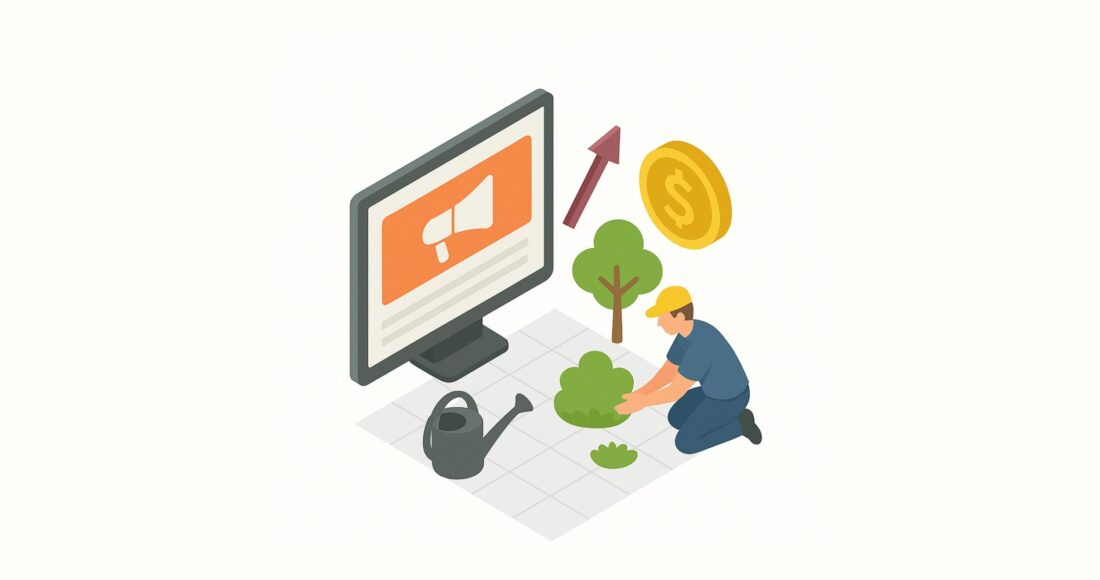
In the landscaping business, word-of-mouth only takes you so far. If you want to consistently attract new customers, fill your calendar, and grow beyond your local competition, you need to advertise — strategically.
But here’s the catch: most landscaping ads fail. They’re either too generic, poorly targeted, or completely missing the visual punch this industry thrives on. That’s where this guide comes in.
Whether you’re a solo lawn care operator or running a full-service landscaping company, this post will show you exactly how to run ads that get real results — without wasting your budget. We’ll break down the best platforms (like Facebook and Google), walk through examples that actually convert, and share practical tips you can implement today.
Let’s start with the obvious question…
Why Landscaping Advertising Still Works in 2025
Advertising isn’t dead. It’s just smarter now — and landscaping businesses that get it right are seeing massive returns.
Here’s why ads still work, especially in the lawn care and landscaping space:
- People are searching now. Homeowners and property managers are actively looking for landscapers — especially before spring and summer. With the right targeting, your ads show up right when they’re ready to book.
- Your work is visual. Unlike plumbing or HVAC, landscaping sells through images. A single photo of a clean lawn or transformed yard can outperform paragraphs of text — and ads are the perfect medium for showcasing it.
- Local targeting is easier than ever. Platforms like Facebook and Google let you target zip codes, neighborhoods, or even income brackets. That means no wasted spend on people outside your service area.
- You can scale what works. Once you find a message and image combo that brings in leads, you can increase your ad spend and scale up — without reinventing the wheel.
- Your competitors are still behind. Many landscaping businesses are still relying on flyers and “boosting posts” with no strategy. This gives you a huge edge if you’re willing to get just a little more tactical.
If you’re running a lawn care or landscaping business in 2025 and still relying only on referrals or random Facebook posts, you’re leaving money on the table. Done right, ads can bring you high-quality leads consistently — and this guide will show you how.
Facebook Ads for Landscaping Companies

Facebook isn’t just for memes and birthday wishes — it’s one of the most powerful platforms for local landscaping businesses to generate leads on autopilot. But success depends on more than just “boosting a post” and hoping for the best.
Here’s how to make Facebook ads actually work for your lawn care or landscaping business:
1. Target the Right People, Not Just Everyone Nearby
Facebook’s strength lies in its targeting. You can zero in on homeowners in specific zip codes, filter by income level, age range, or even behaviors like recent home purchases. This ensures your ad spend only goes to people likely to need your services — not renters or out-of-towners.
2. Use Eye-Catching Visuals (Before & After Works Best)
Your landscaping work sells itself — if you present it properly. Use bold, high-quality images of real projects. Side-by-side before/after shots are especially effective, giving potential customers a clear picture of the transformation you can deliver.
Pro tip: Avoid stock photos. Real work builds trust — and drives clicks.
3. Offer Something They Can Act On Today
Generic ads like “We do landscaping!” get ignored. Instead, lead with an offer:
- “Book Your Spring Cleanup – Slots Filling Fast”
- “Free Quote Within 24 Hours”
- “First Mow Free With Monthly Lawn Service”
Give people a reason to click now, not later.
4. Choose the Right Format
Facebook offers several ad formats that work great for landscapers:
- Carousel Ads: Show multiple services or projects
- Video Ads: Time-lapse yard cleanups perform surprisingly well
- Lead Form Ads: Let users request a quote without ever leaving Facebook
5. Don’t Forget Follow-Up
Even the best Facebook ad won’t convert if no one follows up. Use automation or a CRM to instantly text or email leads when they submit a form. Fast response time = higher close rates.
Negosense stands out among the best CRMs for home service businesses.
Google Ads for Lawn Care and Landscaping

If Facebook is about demand generation, Google Ads is about demand capture. It puts your landscaping business in front of people actively searching for services — often with high intent and credit card in hand.
1. Why Google Ads Work for Landscaping
When someone types “landscaper near me” or “weekly lawn care service,” they’re not browsing — they’re ready to book. Showing up at the top of those results gives you a shot at landing that job before they check your competitors.
Unlike Facebook, where you build awareness, Google lets you target purchase-ready homeowners.
2. Focus on the Right Keywords
Don’t just bid on broad terms like “landscaping.” Instead, focus on high-intent, local keywords like:
- “lawn mowing service [city]”
- “spring yard cleanup”
- “landscaping company near me”
- “mulch delivery and installation”
You can also use negative keywords to filter out traffic you don’t want — like job seekers or DIY searchers.
3. Use Location and Call Extensions
If you’re not using extensions, you’re missing out on conversions. Add your phone number, service area, and a clickable address to make it easy for mobile users to contact you directly. Many leads skip your website entirely and call from the ad.
4. Send Traffic to a High-Converting Landing Page
Avoid dumping traffic on your homepage. Instead, create a page that:
- Matches the search intent (“Book weekly lawn care” or “Get a same-day quote”)
- Loads quickly on mobile
- Has one clear CTA (e.g. “Get a Free Estimate”)
Bonus tip: Include photos, testimonials, and a quote form above the fold so they don’t have to scroll.
5. Track and Optimize
Google Ads is not a “set it and forget it” channel. Monitor your ad performance, pause underperforming keywords, and A/B test your headlines. Even small tweaks can significantly improve your cost per lead.
Want someone to handle this for you? We build and manage landscaping ad campaigns that bring in leads and follow up automatically — ask us how.
Landscaping PPC Advertising: What You Need to Know
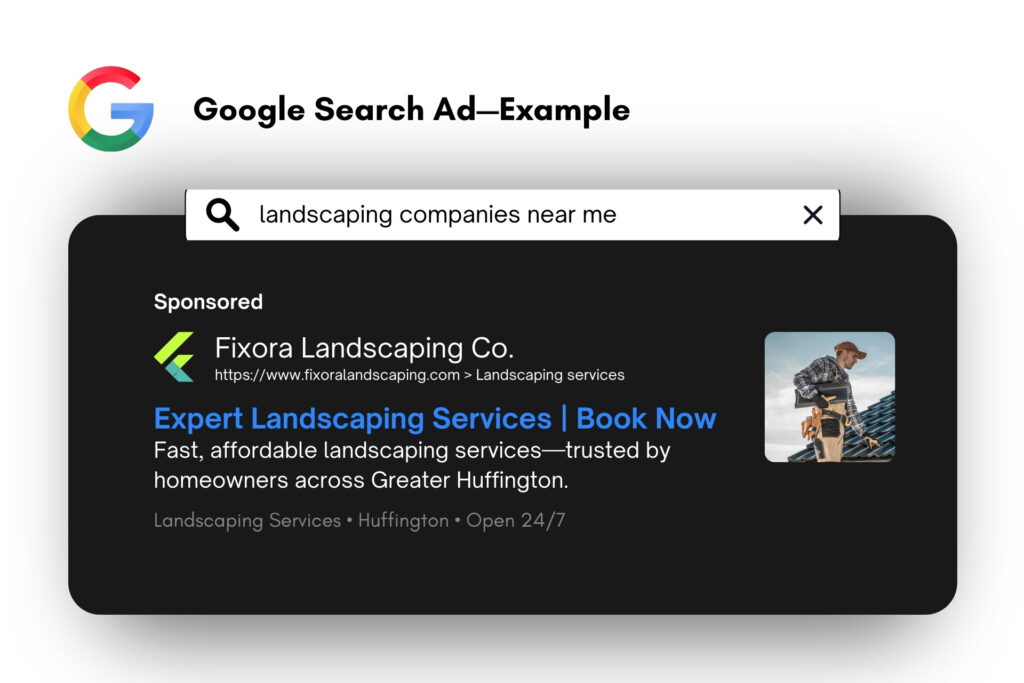
“PPC” (pay-per-click) isn’t just a buzzword — it’s a flexible, scalable strategy that includes platforms like Google Ads, Bing Ads, and even paid placements on local directories. For landscaping businesses, it offers one of the fastest ways to generate qualified leads — if you set it up right.
Here’s what you need to know before jumping in:
1. PPC Is More Than Just Google
Yes, Google dominates the landscape (pun intended), but it’s not the only option. Depending on your market, running PPC ads on:
…can drive serious results at a lower cost. The key is to test and compare.
2. You Pay for Every Click — So Make Them Count
Unlike SEO or organic social media, PPC costs money every time someone clicks. That’s why your ads and landing pages must be dialed in. Otherwise, you’re just paying to send traffic to a dead end.
Avoid vague headlines or generic pages. Speak directly to the service they searched for — “Spring Cleanup in [City] – Get a Quote Today” will beat “Welcome to XYZ Landscaping” every time.
3. Campaign Structure Matters
If you’re lumping all your services into one campaign, stop. Split your PPC campaigns by service type and location. Example:
- Campaign 1: Lawn Care – [City A]
- Campaign 2: Landscaping – [City B]
- Campaign 3: Mulch Delivery – [Service Area]
This gives you cleaner data and better control over your budget.
4. Don’t Rely on Broad Match Keywords Alone
Broad match keywords often waste budget on irrelevant traffic. Use phrase match and exact match for high-intent targeting — and constantly update your negative keyword list to avoid clicks from people looking for jobs, tutorials, or equipment.
5. DIY vs. PPC Management Services
Running your own PPC campaigns is doable, but there’s a learning curve. Mistakes cost money fast. A PPC specialist (or agency) will:
- Set up conversion tracking properly
- Write compelling ad copy
- Optimize bids and keyword targeting
- Improve ROI over time
If you don’t have time to manage campaigns daily, hiring someone to do it right could cost less than the mistakes you’d otherwise make.
DIY vs. Managed PPC for Landscaping Businesses
| Factor | DIY PPC | Managed PPC Services |
| Upfront Cost | Low or none (except ad spend) | Monthly service fee or % of ad spend |
| Control | Full control over every setting | Shared control with a team or agency |
| Time Investment | High – must monitor and tweak ads frequently | Low – most work is handled for you |
| Learning Curve | Steep — PPC platforms are complex | Experts already know the platform inside out |
| Risk of Wasted Spend | High if campaigns aren’t optimized | Lower – pros avoid common money-wasting mistakes |
| Conversion Tracking Setup | Manual — must install and test everything yourself | Included — proper tracking and reporting is standard |
| Ad Copy & Creative | You’re responsible for writing and testing | Professionally written and A/B tested for performance |
| Campaign Optimization | Trial and error | Data-driven strategies based on past results |
| Scalability | Limited by your time and experience | Easier to scale with proven systems in place |
| Best For | Owners who have time to learn and test | Busy business owners who want results, not headaches |
Best Landscaping Advertisement Examples (and Why They Convert)
Most landscaping ads fail not because the business is bad — but because the ad is boring. To stand out in a crowded local market, your ad needs to do more than announce “We cut grass.” It needs to hook attention, spark interest, and create urgency.
Let’s break down real-world ad elements that actually get clicks, calls, and conversions.
Example #1: The “Before & After” Visual Punch
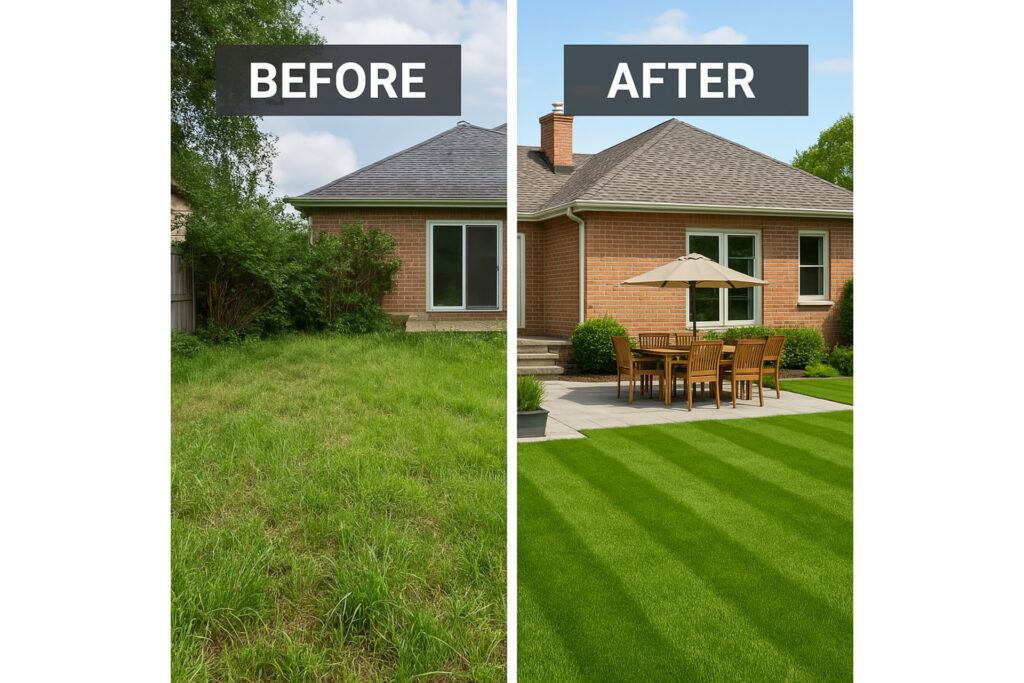
- Why it works: Landscaping is inherently transformational — and showing that transformation triggers curiosity and credibility in one shot.
- Headline idea: “From Overgrown to Outstanding – See the Before & After”
Pairing this with a time-lapse or side-by-side image instantly showcases your value. No extra text needed.
Example #2: Hyper-Local Hook
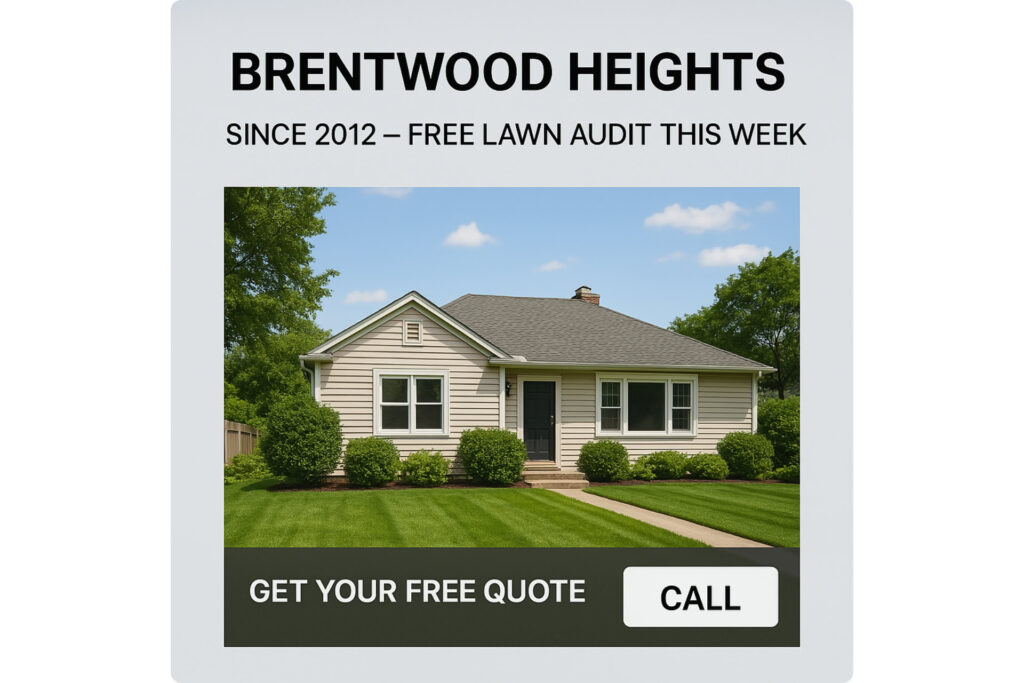
- Why it works: People trust local businesses more — especially if you show you know the neighborhood.
- Ad Copy: “Serving [Neighborhood Name] Since 2012 – Free Lawn Audit This Week Only”
This adds instant relevance and taps into geographic pride. Bonus: it improves clickthrough rates with localized targeting.
Example #3: Limited-Time Offer
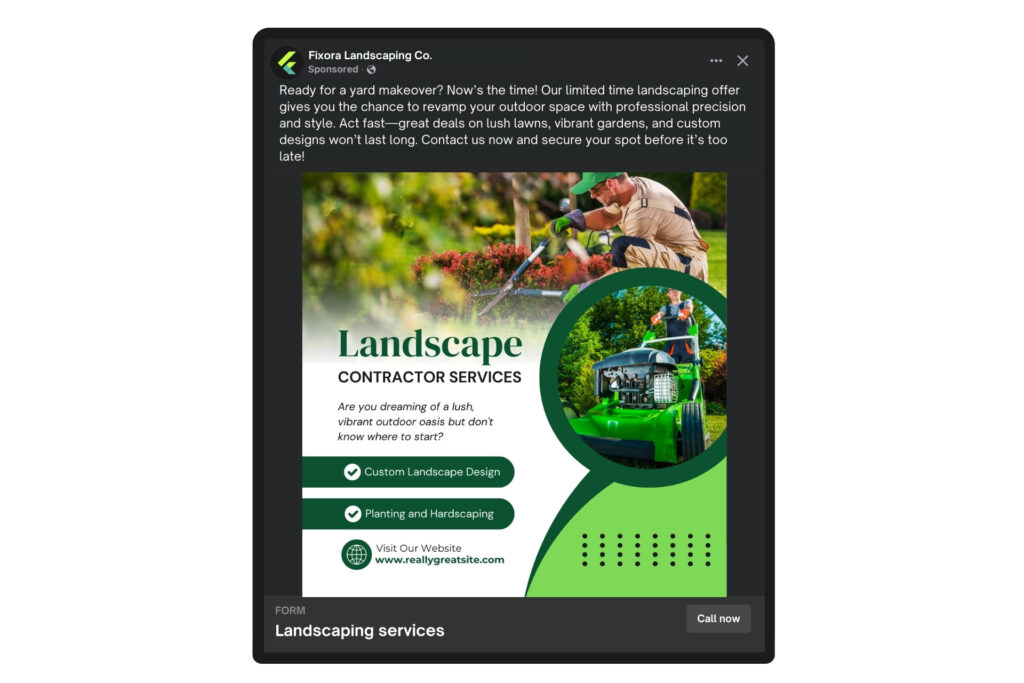
- Why it works: Urgency drives action. Adding time-sensitive incentives gets potential customers off the fence.
- Headline idea: “Spring Cleanup Special – Book by Friday, Save 15%”
Even a modest discount or bonus (like free edging or mulch delivery) can tip someone toward booking.
Example #4: Problem-Solver Angle
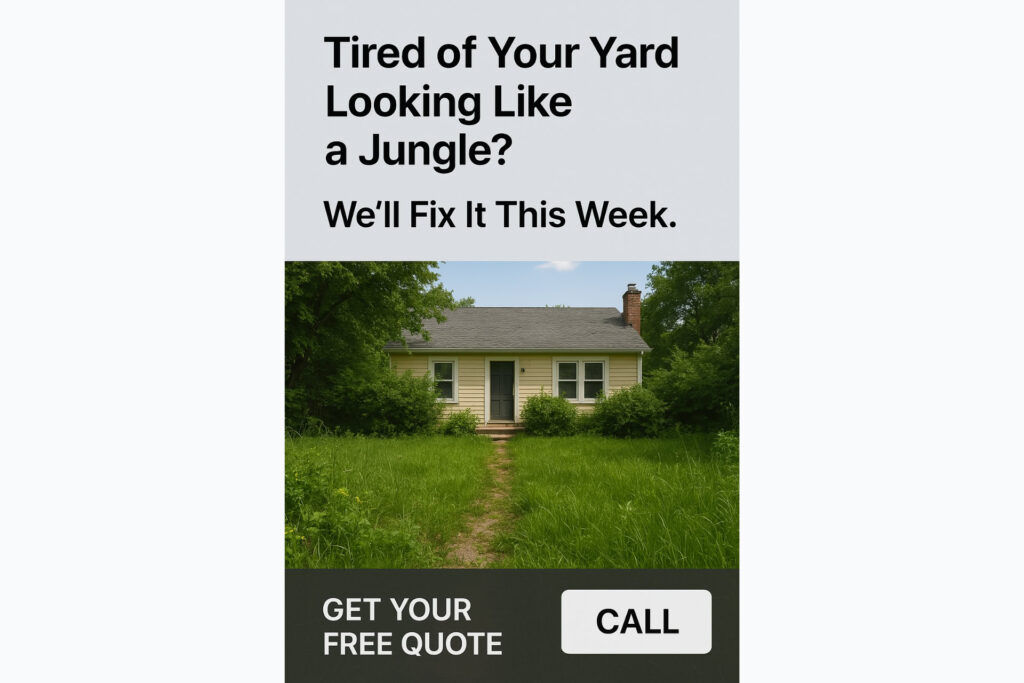
- Why it works: Not everyone’s looking for “landscaping” — but they are trying to fix something.
- Ad Copy: “Tired of Your Yard Looking Like a Jungle? We’ll Fix It This Week.”
This addresses a pain point directly, making your service feel like a no-brainer solution.
Example #5: Review-Driven Trust Ad

- Why it works: Social proof matters. Featuring a real customer testimonial or your star rating adds credibility instantly.
- Ad Copy: “★★★★★ 4.9 Stars on Google – ‘Our Lawn Has Never Looked Better!’ – Anna, Springfield”
Pair this with a happy customer photo or logo badge, and you’re golden.
Quick Tips for High-Converting Landscaping Ads:
- Always use real photos of your work
- Keep copy short and benefits-focused
- Use clear CTAs: “Get a Free Estimate,” “Schedule a Walkthrough,” “Call Now”
- Test different formats: static image, carousel, and short video
Visual quality and message clarity matter more than anything. A stunning ad with a weak CTA will flop — and a killer offer with bad photos won’t even get noticed.
How to Budget for Landscaping Ads Without Burning Cash
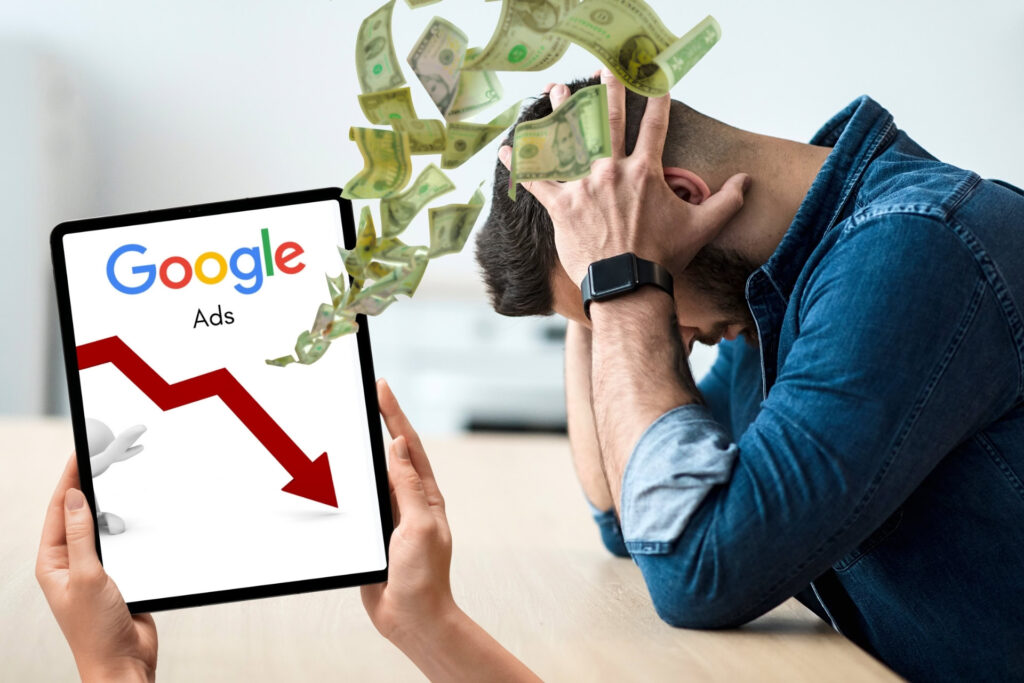
Spending money on ads can feel like gambling if you don’t have a strategy. But when done right, paid ads become a predictable growth engine — not a shot in the dark.
Here’s how to approach your landscaping ad budget like a smart business owner, not a hopeful guesser.
1. Start With a % of Monthly Revenue
A common rule of thumb is to reinvest 5–10% of your monthly revenue into advertising. If you’re in growth mode, going up to 15% is totally reasonable.
- Example: If your business brings in $10,000/month, a starting ad budget of $500–$1,000/month is right on track.
It’s not about spending more — it’s about spending with purpose and tracking results.
2. Separate Testing Budget From Scaling Budget
Your first 2–4 weeks should be treated as a testing phase. This is where you:
- Identify your most profitable services and offers
- Compare platforms (Google vs. Facebook)
- Test headlines, images, and targeting strategies
Start with a modest daily budget — say $10–$25/day — and only scale once you know what’s working.
3. Track Your Cost Per Lead — Not Just Clicks
Clicks don’t pay the bills. Cost per lead (CPL) is the number to watch.
If you’re paying $8–$15 per qualified lead that turns into a $300–$1,000 job, you’re winning.
Use simple tools to track this:
- UTM links with Google Analytics
- Lead form conversion tracking
- CRM integrations (our system does this automatically)
4. Cut Fast, Double Down Faster
If a campaign hasn’t generated leads after 7–10 days and a few thousand impressions, don’t wait. Pause it, adjust your targeting or creative, and test again.
But if you’ve got a campaign that’s converting? Scale it. Increase your daily spend or extend it to other neighborhoods or services.
Pro tip: Scaling doesn’t always mean spending more. Sometimes, it means doubling down on what already works — just with a tighter focus.
5. Budget for Follow-Up, Not Just Clicks
Most landscaping businesses don’t lose money on ads because the ads are bad — they lose money because no one follows up fast enough.
Lead comes in. No response. Opportunity lost.
Make sure your ad budget includes tools or systems to respond instantly via text, email, or call. This is where automation and a smart CRM make all the difference.
Bottom Line:
Budgeting for landscaping ads isn’t about throwing money at Facebook or Google — it’s about testing smart, tracking performance, and doubling down on what works.
And if you want a team that can handle the entire process — from campaign setup to automated follow-up — we’re ready when you are.
FAQs: Best Advertising Channels for Landscaping Companies
If you’re running a landscaping or lawn care business and thinking about ads, these are the questions you’re probably asking. Here are the real answers — no fluff, no agency-speak.
What’s the best platform for landscaping ads in 2025?
It depends on your goal.
- Use Google Ads to get in front of people actively searching for services (high intent).
- Use Facebook Ads to generate demand and stay top of mind with local homeowners.
The most effective strategy? Use both — Google to convert ready buyers, Facebook to keep your pipeline full.
Do lawn care Facebook ads still work?
Absolutely — when done right.
Facebook is still one of the cheapest and most powerful ways to reach homeowners. But don’t just “boost a post.” Use Ads Manager to control targeting, placement, and creative. The right mix of visuals, a strong offer, and tight targeting still works like a charm.
How much should I spend per month on ads?
Most local landscaping businesses start with $300–$1,000/month in ad spend.
The key isn’t how much you spend — it’s how well you convert the leads that come in. Even a $10/day campaign can generate a solid ROI if your follow-up is fast and your offer is strong.
What kind of ads work best for lawn mowing services?
Simple, visual, and local.
Use real photos — before/after shots, clean mowing lines, etc. Pair that with a clear message:
- “Weekly Lawn Mowing in [Your City] — First Cut Free”
Or
- “Schedule Now for Next-Day Service”
Google Ads also work well here by targeting searches like “lawn mowing near me” or “weekly yard service.”
What’s the best advertising strategy for growing fast?
Use a paid ads + automation combo:
- Google Ads to catch people searching for help now
- Facebook Ads to stay visible locally and generate leads
- Dedicated landing pages built for conversions
- Automated follow-up via text/email/call to close the deal fast
This stack gives you both quality and scale — and it works.
Do I need a CRM to run ads?
Yes — if you want your ads to actually work.
A CRM makes sure:
- Every lead gets followed up with (automatically, if needed)
- No one falls through the cracks
- You can track which campaigns are generating real revenue
Our growth system includes a built-in CRM designed for home service businesses — complete with automated responses, appointment booking, and reporting. If you’re spending money on ads without one, you’re leaking profits.
Book your free strategy call now, and let’s turn your ad budget into booked jobs.
Ready to Run Landscaping Ads That Actually Bring You Customers?

Let’s be honest — most ads for landscaping and lawn care don’t work. Not because advertising doesn’t work, but because the strategy behind them is weak.
You’ve seen it:
- Generic “boosted posts.”
- Click-throughs with no follow-up.
- Leads slipping through the cracks.
- And money going out with nothing coming in.
We don’t do that here.
What You Get When You Work With Us:
- Strategic Google and Facebook ad campaigns tailored to your local market
- Conversion-optimized landing pages designed to turn clicks into booked jobs
- Automated follow-up systems so no lead goes cold
- Clear reporting that shows what’s working, what’s not, and where your money’s going
We don’t sell fluff. We build growth systems.
Here’s the Offer:
We’ll build and launch your entire system — ads, landing pages, automation, the works — for a flat upfront fee that pays for itself as soon as the leads start converting.
And to keep it low-risk?
We don’t lock you into long-term contracts.
If it’s not working, you walk. No drama, no fine print.
But we’re confident you’ll stay — because it works.
Ready to grow?
Schedule your strategy call. Let’s build a system that brings you qualified leads month after month — without you chasing them down.
Related Articles
Landscaping & Lawn Care Services
- How to Get Landscaping Leads: 9 Proven Ways to Book More Jobs in 2025
- The Truth About Finding Lawn Care Customers in 2025
- The Ultimate Guide to SEO for Landscapers: Get More Clients Online in 2025
- Landscaper Marketing: The Ultimate Guide to Growing Your Lawn Care Business in 2025
- The Best Lawn Care Software for Your Business: Why Customization Beats Generic Solutions